B-52 Crash, United 169 Light Pole Strike, Skydiving Tragedy, and Oshkosh Stall
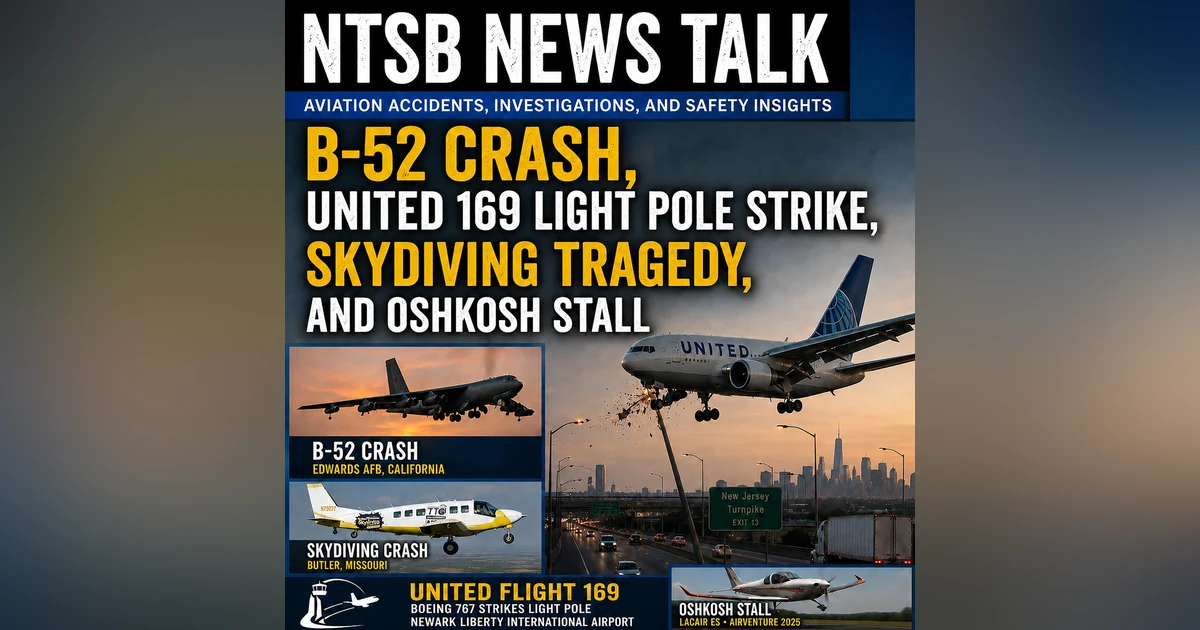


In NTSB News Talk #32, Max Trescott and Rob Mark examine two major new aviation accidents, a dramatic United 767 light pole strike at Newark, and several newly released NTSB final reports that highlight familiar accident themes: unstable approaches, low-altitude decision-making, maintenance neglect, traffic-pattern workload, weather surprises, visual illusions, and delayed instructor intervention.
Brought to you by AVEMCO aircraft insurance.
Support Rob and Max by making a donation at Patreon.com
The episode opens with two breaking accidents. The first is the crash of a U.S. Air Force B-52 Stratofortress shortly after takeoff from Edwards Air Force Base in California’s Mojave Desert. Early reporting said the bomber crashed around 11:20 a.m. local time on June 15, 2026, with emergency crews responding immediately. Details about the crew, mission, and cause were not available at the time of recording. Because the B-52 is a military aircraft, the investigation will not follow the normal NTSB civil-aircraft path, but the accident is significant because of the aircraft’s role in U.S. strategic bomber operations and the B-52 fleet’s continuing modernization.
The second major new accident is the fatal crash of a skydiving aircraft near Butler Memorial Airport in Butler, Missouri. The aircraft was identified in reporting as N221BN, a Pacific Aerospace 750XL/P-750 operated for Skydive Kansas City. All 12 people on board — the pilot and 11 skydiving passengers — were killed. Early reports say the airplane had just taken off, appeared to have trouble gaining altitude, turned left, and crashed near the airport. Max discusses why parachute jumpers on a takeoff-climb accident aircraft may have no practical chance to exit: normal skydiving deployment altitudes are measured in thousands of feet, and even after a jumper pulls, a parachute can use several hundred feet before the canopy is fully open and flying. The accident also renews attention on jump aircraft maintenance, inspection programs, high-cycle operations, pilot training, and FAA oversight of parachute operations.
Rob then reviews the fatal crash of a U.S.-registered Gulfstream G200, N318JF, at La Romana International Airport in the Dominican Republic. The airplane had departed La Romana for a repositioning flight to Austin-Bergstrom International Airport in Texas, but shortly after takeoff the crew reported an in-flight emergency. Although the specific emergency had not yet been verified, early reports suggested a possible engine failure. The crew returned toward La Romana, reportedly jettisoned fuel, attempted one approach, went around, then later attempted a landing on another runway with a tailwind component. ADS-B data showed a very high final descent rate, and video showed the main gear collapse before the airplane slid and caught fire.
Max next discusses N858SD, a fatal Cirrus SR20 accident at Greater Portsmouth Regional Airport in Ohio. The airplane crashed into a house shortly after takeoff, killing the private pilot. Max notes that little was known at the time of recording, but online reports suggested the same pilot had survived a previous SR22 accident in February 2025 after encountering freezing rain. That earlier accident involved N406SR, a non-FIKI-equipped 2006 SR22, TKS limitations, ice accretion, an iced windshield, and a landing undershoot.
The preliminary report segment focuses on United Flight 169, a Boeing 767-424ER arriving at Newark from Venice. The flight was originally planned for Runway 4R, then changed to Runway 22L, and finally to Runway 29. The crew was assigned the RNAV W Runway 29 approach, a demanding procedure with multiple turns and a visual segment that begins near AXELL. The final turn occurs at NOWAY, only about 1.4 miles from the runway threshold. According to the preliminary report, the first officer called out that the aircraft was slow and low, but a go-around call was not made before touchdown. The aircraft descended below the intended visual path, struck a light pole near the New Jersey Turnpike, and landed safely. Debris from the pole struck a tractor-trailer, whose driver received minor injuries. Max and Rob discuss the difficulty of stabilizing a large transport aircraft on a short, turning visual segment in gusty conditions, and how a crew can become focused on one parameter while another deteriorates.
Rob then covers N4167G, a Cessna 402B crash near Rafael Hernández Airport in Puerto Rico. The NTSB found that the pilot operated the aircraft with numerous known maintenance discrepancies, leading to a total loss of right-engine power. The aircraft had flown only 1.4 hours in more than four years, had not been signed off as airworthy after a recent inspection, and had significant unresolved engine and airframe issues. Rob frames the accident as a reminder to ask how an airplane has been maintained before trusting it.
Max reviews N18BG, a Lancair ES crash at Oshkosh during AirVenture. The pilot was instructed to widen his turn to allow two warbirds to land ahead. ADS-B data showed the airplane slowing while maneuvering, and the NTSB concluded that the pilot failed to maintain adequate airspeed, exceeded the critical angle of attack, and stalled. Max and Rob discuss the unique workload of flying into AirVenture, especially single-pilot.
The episode also includes N3464D, a Champion 7GCBC accident near Eatonville, Washington, where witnesses described a low, slow, nose-high departure near trees and rising terrain before the airplane rolled and descended. Max adds that terrain and fading light can create misleading horizon cues. Another final report involves N14137, a 1934 WACO YKC that encountered unexpected fog and low IFR conditions in Kansas. Radar data suggested the pilot attempted to climb and turn away before losing control. The final accident involves N6310N, a Citabria 7ECA training flight in California, where the aircraft overshot a grass runway and struck a fence and trees. Max closes by discussing instructor intervention, cockpit distractions, and the importance of actively identifying distractions before they compromise safety.