LaGuardia Runway Collision, Challenger 600 Dual Engine Flameout, and More NTSB Accident Reports


LaGuardia Runway Collision and Firetruck Crossing
In this episode of NTSB News Talk, Max Trescott and Rob Mark begin with the LaGuardia runway collision involving Jazz Flight 646 and an airport firetruck that was cleared to cross runway 4 shortly before the landing regional airliner arrived. The collision occurred during an emergency response on another part of the airport, creating a fast-moving chain of events involving air traffic control, a responding firetruck, runway status lights, and a landing aircraft.
Max walks through the timing in detail. Jazz Flight 646 had already been cleared to land on runway 4 and was on short final. Truck One was stopped on taxiway Delta, about 460 feet from the runway edge. The firetruck crew requested clearance to cross runway 4, and the local controller cleared the truck to cross. At that point, the aircraft was only seconds from touchdown. The truck began moving toward the runway, the controller then instructed it to stop, and repeated the stop instruction. By the time the aircraft had touched down, braking had begun, thrust reversers were deployed, and the firetruck was still moving toward the runway.
A key part of the discussion involves the runway status light system at LaGuardia. Max explains how runway entrance lights, or RELs, illuminate red to warn taxiway traffic that runway traffic is approaching. But the system is designed so the lights extinguish a few seconds before the arriving aircraft reaches the taxiway intersection. That timing supports anticipated separation and allows controllers to move airport traffic more efficiently. In this accident, however, the design logic may have broken down because the firetruck was already rolling toward the runway when the red lights went dark. The episode highlights why a system designed for efficiency can still leave a dangerous gap when a fast-moving airport vehicle is involved.
Brought to you by AVEMCO aircraft insurance.
Support Rob and Max by making a donation at Patreon.com
Challenger 600 Dual Engine Flameout Near Naples
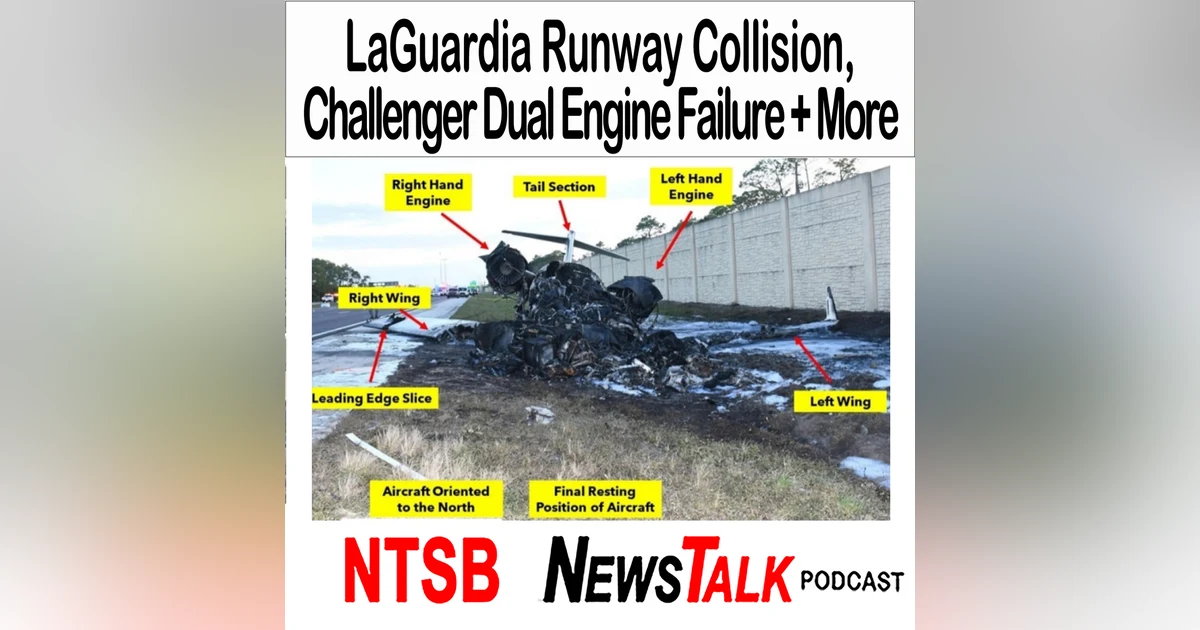
The second major focus is the final NTSB report on Bombardier Challenger 600 N823KD, which crashed on Interstate 75 near Naples, Florida after both engines lost thrust. The airplane was on approach when both GE CF34-3B turbofan engines suffered near-simultaneous sub-idle rotating compressor stalls. The NTSB cited corrosion in both engines’ variable geometry system components as the cause of the dual engine flameout.
Rob explains that the engines had experienced multiple hung starts before the accident. Maintenance troubleshooting had included fuel checks, filter replacements, and engine runs, but the underlying corrosion problem was not identified. The aircraft had spent earlier years operating in Barbados, raising the broader issue of corrosion exposure in aircraft based near saltwater environments.
The Challenger crash also includes an important survivability lesson. After the aircraft came to rest on the interstate, fire blocked the normal cabin and emergency exits. The flight attendant helped evacuate the passengers through the baggage compartment door in the tail section of the airplane. Her training reportedly did not include using that door as an emergency exit, but she knew how to open it because she had previously helped pilots load baggage. Max uses this as a reminder that knowing more about an aircraft than the minimum required can sometimes save lives.
Mooney M20J Engine-Out Accidents
The episode also covers two Mooney M20J accidents. Mooney M20J N1151H crashed short of runway 5 at Union County Airport in South Carolina after the pilot reported an engine issue while cruising at 6,000 feet. The pilot reached the airport area but made a high-speed low pass, then flew a wide pattern while trying to lose altitude and airspeed. The airplane crashed about a quarter mile short of the runway, killing all four people on board.
Max and Rob discuss the central lesson from that accident: reaching the airport is not the same thing as making the runway. In an engine-out situation, pilots must manage altitude, speed, distance, and pattern size so the runway remains assured. Max emphasizes that landing long and rolling off the far end at low speed is usually far more survivable than coming up short.
A second Mooney M20J N205MK crashed near Ironton, Ohio shortly after departing Ashland Regional Airport in Kentucky. The airplane climbed, accelerated, then began descending and slowing before the final ADS-B point. The cause remains unclear, but Max notes that the profile suggests a possible takeoff emergency or engine failure.
Bonanza, Bell 206, King Air, and Extra 300L Reports
Rob also discusses Beech F-33A Bonanza N8032X, which crashed shortly after takeoff from Minneapolis Crystal Airport. The airplane entered a left turn and never climbed above about 200 feet AGL. If the pilot was attempting to return to the airport, the altitude was far too low for a successful turnback. The accident reinforces the importance of reviewing emergency landing options before takeoff.
Another unusual ground accident involved Bell 206 N409AE near Chapmansboro, Tennessee. A medevac crew was preparing to load a patient when a stretcher rolled into the helicopter’s tail rotor. No one was injured, but the accident shows how ground equipment can become a serious hazard around running aircraft.
The episode also reviews Beech A36 Bonanza N2882W, which crashed near Olympic Valley, California after the pilot reported a turbocharger problem while inbound to Truckee Tahoe Airport. Max describes the terrain southwest of Truckee as extremely inhospitable, with high mountains and few forced landing options.
Rob then covers Beech Super King Air B200GT N886DS, which entered a dramatic high-speed loss of control near Sharp, Louisiana after the pilot asked to leave the frequency briefly at flight level 280. The autopilot disconnected, the aircraft entered a steep right bank, bank angle alerts sounded, and the airplane descended at extreme rates before impact.
Finally, Max and Rob discuss Extra 300L N22MW, which crashed near Bandera, Washington. The non-instrument-rated pilot likely encountered IMC and icing while flying through mountainous terrain to attend an aerobatic camp. The accident illustrates the danger of self-induced pressure, especially when a pilot feels responsible for completing a flight so others can proceed with an event. Finally, they talk about N2387B, a Globe GC-1B that crashed while in a flat spin.