Piper Seminole Crash, Cirrus SR22 Hard Landing, Mooney Door-Pop Spin



A Week of Accidents With the Same Underlying Lesson
Max Trescott and Rob Mark talk about a long list of recent accidents and final reports, including Beech 58 Baron N2063G, Sling N166TW, Piper Saratoga N4190E, Cirrus SR22 N124SP, Cirrus SR22 N285AH, Mooney M20K N4387W, Piper PA-44 Seminole N595ND, Cessna 172P N781FM, and Mooney M20E N5632Q. The airplanes are different, the missions are different, and the outcomes range from minor damage to fatal crashes, but the pattern is remarkably consistent. Pilots get distracted, fly unstable approaches, press a bad situation, or lose control while trying to recover from something that should have remained manageable. This episode is really about how ordinary mistakes, not exotic failures, continue to drive many general aviation accidents.
Max and Rob begin with a brief discussion of an unusual cluster of incidents at North Perry Airport in Florida, where several aircraft had problems within a few hours. That leads into the larger point that flying risk does not begin and end in cruise. Taxi, takeoff, landing, and ground handling are all phases where small errors can quickly compound.
Multiengine Training Can Turn Deadly Fast
One of the most sobering cases is the Beech Baron crash in Tennessee, which Max says looks very much like a VMC demonstration that turned into a stall-spin. He notes that VMC demos remain one of the most dangerous multiengine training maneuvers because they intentionally move close to a loss-of-control boundary. His advice is practical and memorable: if you are doing multiple maneuvering exercises in a twin, do the VMC demo first, before other stalls and recoveries condition the pilot to respond the wrong way.
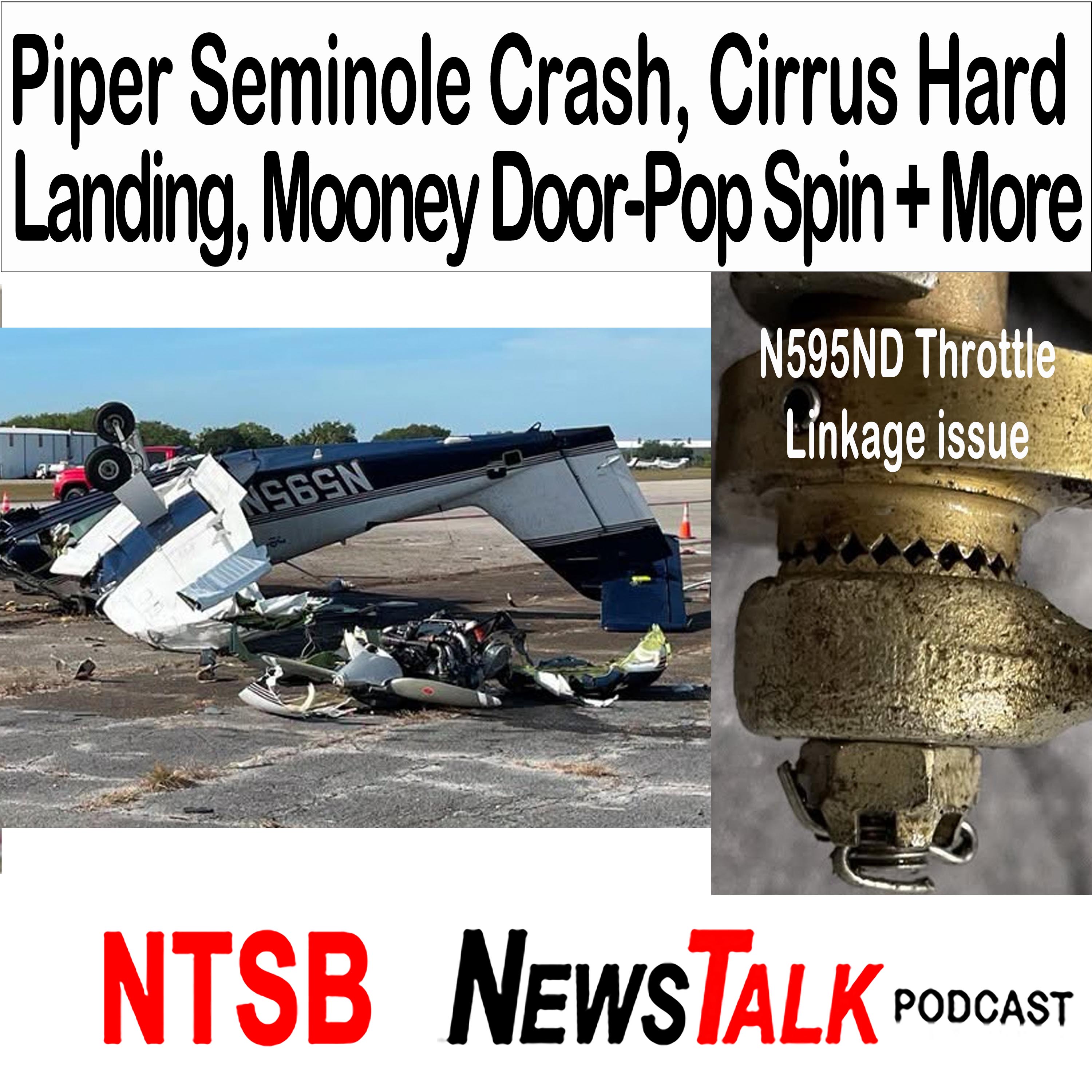
That lesson becomes even sharper in the discussion of the Seminole training crash in Fort Pierce. During a flight involving single-engine work, the airplane suffered a partial power problem on one engine, and the crew attempted to continue flying and get back to the runway. The result was a stall, rollover, and fatal crash. The maintenance issue matters, since a throttle-linkage problem was involved, but Max and Rob focus on the operational truth that matters more to listeners: a light twin with one engine compromised is not a magic carpet. If the aircraft is low, slow, dirty, and out of position, trying to save the landing may be what kills you. Their conclusion is blunt but correct. A controlled off-airport landing is often the better outcome.
Fast Approaches Keep Showing Up
The St. Paul hard landing involving the Minnesota State Patrol Cirrus becomes one of the central teaching moments in the episode. Max compares the recorded speeds with recommended Cirrus pattern and approach targets and finds a familiar story. The airplane was fast on downwind, got closer to target speed on base, then crept fast again on final after power was added. The approach was not fully stabilized, and the landing sequence deteriorated from there.
Rob’s fatal Saratoga overrun case reinforces exactly the same point from a different angle. The pilot was forced to use a shorter runway because the longer one was closed, but runway length alone was not the real problem. The airplane crossed the runway at a speed that left far too much kinetic energy to dissipate. Rob explains this well: landing just 20 or 25 knots fast is not a small deviation. It can radically change stopping distance because the brakes have to absorb far more energy than they were ever meant to handle in a normal landing.
This is one of the strongest themes in the episode because it applies to so many pilots. Many believe they are being conservative when they carry extra speed. In reality, they are often creating the exact conditions that lead to runway excursions, hard landings, porpoising, or loss of control during a late go-around. The lesson is not subtle. Flying a stable approach at the correct speed is not optional. It is one of the foundations of safe flying.
Startle, Distraction, and the Human Factor
The Mooney crash in St. Augustine may be the best example of how a minor problem becomes a fatal one when it hijacks the pilot’s attention. Shortly after takeoff, a cabin door popped open. The pilot returned to the airport, but instead of simply flying a normal pattern and landing, the airplane stalled and spun. The discussion here is less about mechanical failure and more about startle response. An open door is loud, sudden, and emotionally disruptive. It may not impair the airplane much, but it can absolutely impair the pilot.
Max and Rob both make the point that pilots should be trained for this better than they are. Instructors routinely simulate engine failures and other obvious emergencies, but many never expose pilots to the shock of a door popping open. That is a gap in training, because surprise itself is often the emergency.
A similar human-factors lesson appears in the Fullerton Cirrus runway excursion, where the pilot seat slid back on takeoff. That event was not fatal, but it is another reminder that small cockpit issues can become major control problems at exactly the wrong time.
Smaller Cases, Same Core Message
The Catalina Sling crash appears to involve aggressive low-level maneuvering near terrain, leaving almost no margin once the airplane crossed rising ground and dropped into a valley. The Cessna forced landing in Maryland highlights a different blind spot: carb ice during a low-power descent. Max points out that many pilots think about carb heat mostly in the traffic pattern, when they should also be thinking about it during prolonged descents at reduced power.
The final accident, involving a portable lithium battery pack that ignited after being dropped and then placed back in a Mooney, is memorable because it feels so ordinary. Most pilots would worry that the device no longer worked, not that it had turned into a fire source. But that is the larger theme of the whole episode. Aviation accidents often begin with something ordinary: a little extra speed, a loose door, a seat not fully locked, a damaged battery, an engine that does not respond as expected. The deciding factor is what happens next.
What Max and Rob keep returning to is simple and worth repeating: fly the numbers and stop trying to salvage unstable situations.