Runway Close Calls, Skydiving Crashes, Citation Latitude Fatal Crash & Cirrus Icing CAPS Pull
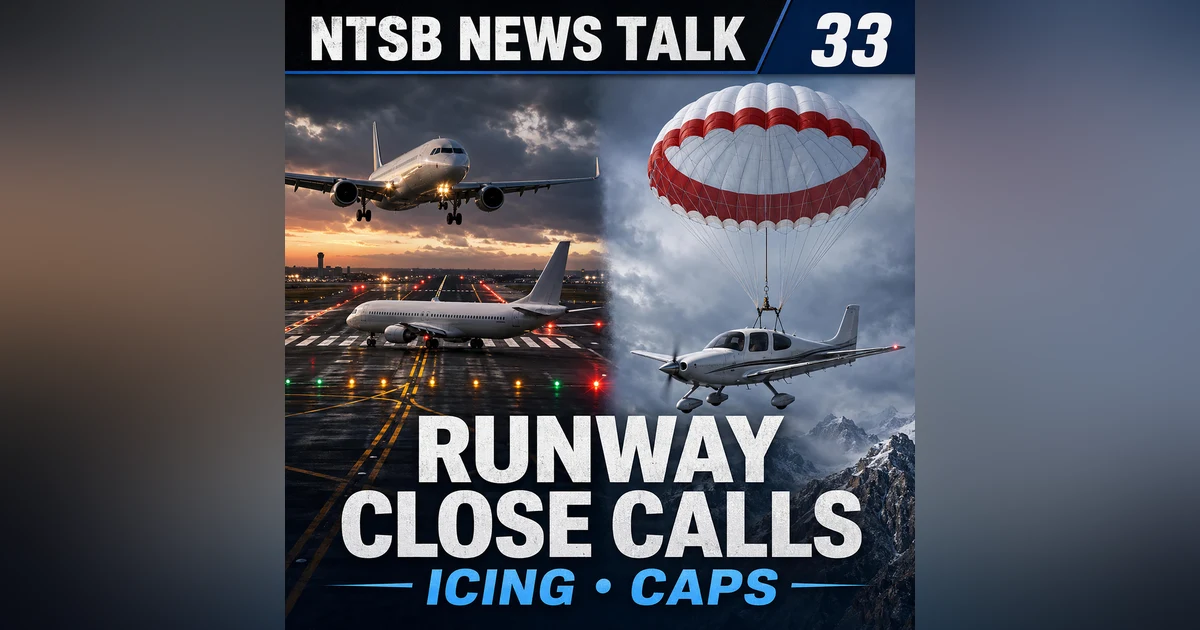


Max Trescott and Rob Mark open Episode 33 of NTSB News Talk by noting that general aviation accident activity often rises during the summer months because more flying is taking place. They stress that this does not make accidents acceptable or less tragic, but it does help explain why there are more recent events to choose from during this time of year.
Brought to you by AVEMCO aircraft insurance.
Support Rob and Max by making a donation at Patreon.com
The first segment looks at a runway close call at Boston Logan involving Delta Air Lines Flight 2351 and American Airlines Flight 3161. Delta 2351 was landing on Runway 33 Left while American 3161 was departing Runway 27, an intersecting runway. Rob explains that the controller appeared to have a plan: clear Delta 2351 to land and American 3161 for takeoff. The problem was that American 3161 did not begin the takeoff roll immediately after receiving clearance. Because controllers often build their timing around the expectation that an aircraft will begin moving promptly once cleared for takeoff, that delay changed the situation. Delta 2351 saw the conflict developing and initiated a go-around. Max emphasizes that pilots should maintain a big-picture view during landing and takeoff, listening to all radio calls and scanning the runway environment instead of focusing only on their own clearance.
The next event occurred at Miami International, where American Airlines Flight AA308, an Airbus A319 bound for Bermuda, rejected takeoff after the crew saw NetJets Flight EJA434, an Embraer Phenom 300, N434QS, on the runway. Rob explains that the Phenom 300 crew apparently believed they had been cleared to cross, but the clearance had actually been issued to another aircraft for a different runway. Max and Rob use the event to reinforce the importance of careful clearance readbacks, active listening, and visual confirmation, especially at complex airports.
The episode then turns to the fatal crash of a Pilatus PC-6/B2-H4 Turbo Porter, D-FIPS, shortly after takeoff from Nancy-Essey Airport in France. All 11 people on board were killed. Max notes the eerie similarity to a U.S. skydiving aircraft crash discussed in the previous episode, which killed 12 people just two weeks earlier. He explains that his quick review of the broader accident history did not suggest that skydiving aircraft are necessarily worse than other general aviation aircraft overall, but the clustering of two mass-fatality skydiving aircraft crashes was deeply tragic.
Another skydiving-related event involved a Cessna 208B Grand Caravan EX, N593EX, at Marana Regional Airport in Arizona, where a Skydive Marana employee died after exiting the aircraft and walking into the still-running propeller. Max says he previously researched propeller accidents and found that many appear in news reports but not necessarily in the NTSB database. He and Rob both argue that these accidents should be preventable, and Max states his own rule: nobody enters or exits his airplane while the propeller is turning. The inconvenience of shutting down is minor compared with the severity of a propeller strike.
Rob then discusses the June 16 crash of a NetJets Cessna 680A Citation Latitude, N523QS, near Laredo, Texas. The aircraft had departed San Jose del Cabo, Mexico, bound for Austin, and crashed during an emergency landing attempt near Laredo. One of the six occupants was killed. Rob notes that details were still limited but that the emergency may have involved fuel status or power loss. Max raises a possible international fueling gotcha: aircraft fueled outside the United States may be serviced in liters rather than gallons, creating a potentially serious mismatch if the units are misunderstood. He is careful not to claim this caused the accident, but highlights it as a reminder that pilots must verify every detail when operating internationally.
Max next covers the fatal nighttime crash of a Piper Archer, N249WF, near Bowie, Maryland, that killed the newly certificated private pilot and two student pilots. The aircraft had flown from Montgomery County Airpark to Ocean City, then later departed after three night pattern circuits. On the return flight, N249WF descended while squawking 7700 and crashed about 23 miles short of the destination. Max discusses several possible scenarios, including engine failure, fuel exhaustion, and carburetor ice. The local temperature and dew point placed the conditions within a carb-ice risk envelope, reminding listeners that carb ice can occur even when the outside air temperature feels warm.
Rob then describes a float-equipped Cessna 195, N3877V, that struck power lines near the Cable Bridge south of Pasco, Washington, and crashed into the Columbia River, killing both occupants. The aircraft was reportedly attempting to land on the river, though there was no official seaplane base there. Rob notes that the wires were not equipped with orange marker balls and were not specifically shown on the VFR sectional. Max points out that seaplanes eventually must get low for landing, but that low-altitude operations contain many hazards, especially wires.
Max briefly previews the New Mexico Part 135 air ambulance crash of a Beech C90 King Air, N249CP, that he covers in greater detail on Aviation News Talk. The aircraft crashed into mountainous terrain at night during a short flight from Roswell to Sierra Blanca Regional Airport to pick up a patient. Factors included a non-working AWOS and military GPS jamming, but Max says the flight still could have been conducted safely.
The final reports begin with a Cirrus SR22T, N285AH, accident at Fullerton, California, where the pilot’s seat slid aft during takeoff, leading to loss of control and substantial damage. Max explains that although sliding seats are often associated with older Cessnas, he has personally seen seat-slide events in Cirrus aircraft. He recommends that pilots physically check that their seat is locked before takeoff and install any available safety modifications.
The final accident involves a Cirrus SR20, N619AV, that encountered icing in Arizona. The pilot continued into precipitation and IMC, accumulated rime ice, stalled, and deployed CAPS. Max emphasizes that a 180-degree turn is often one of the best early escape strategies after encountering ice. He also addresses the pilot’s concern about turning into a tailwind, explaining that in a steady air mass, a tailwind changes groundspeed but does not reduce the airplane’s aerodynamic performance. The real issue in a turn is bank angle, load factor, stall speed, and the already degraded margin caused by ice.