Helicopter Flying in New Zealand: Billy Watson on Milford Sound + Helicopter News
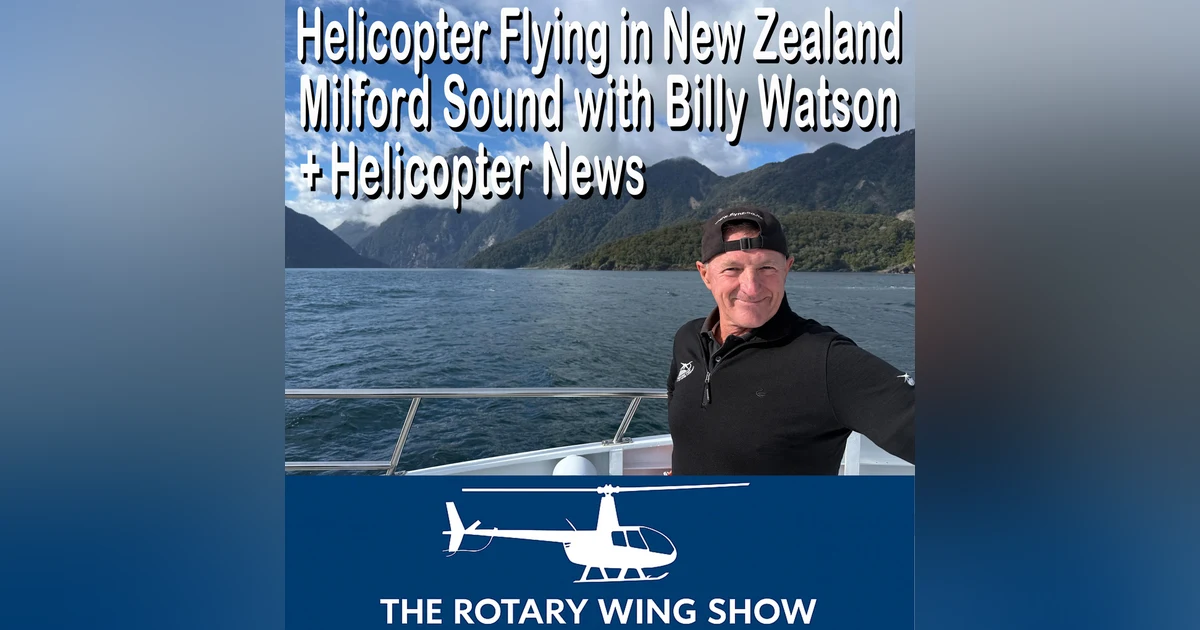
Max talks with New Zealand helicopter pilot Billy Watson about flying in some of the most dramatic terrain in the world, from Queenstown and Milford Sound to Papua New Guinea and the Western Pacific.
Billy flies for Over The Top, a Queenstown-based helicopter company that specializes in bespoke scenic helicopter experiences. In this conversation, recorded aboard the Milford Explorer cruise boat in Milford Sound, Billy explains why weather plays such a major role in New Zealand helicopter operations, especially around the fjords, mountains, cloud, wind, and rain of Fiordland.
Billy also shares how he first became interested in helicopters while working as a government-paid hunter controlling feral goats, then moved into venison recovery, Hughes 500 operations, tuna spotting, Papua New Guinea seismic flying, and BK117 work. Along the way, he learned hard lessons about low-level helicopter flying, passenger briefings, risk, and decision-making.
Max also discusses several recent helicopter accidents, including a Hughes 369D accident in Hawaii involving high-frequency vibration and loss of yaw control, plus final reports involving an AS350B2 in flat light, an R66 hover taxi distraction, and an R22 dynamic rollover.


 RSS Feed
 Helicopter Flying in New Zealand’s Most Dramatic Terrain
Max talks with New Zealand helicopter pilot Billy Watson during a visit to Milford Sound, one of the most spectacular helicopter flying environments in the world. The conversation was recorded aboard the Milford Explorer cruise boat, after Max met Billy while Billy was accompanying clients on a Milford Sound helicopter and cruise experience.
Billy flies for Over The Top, a Queenstown-based helicopter company that specializes in customized scenic helicopter flights. The company operates Airbus EC130s and AS350 Squirrels and focuses on clients who want something more personalized than a standard sightseeing flight. Billy describes the company’s approach as highly customer-focused: if a trip can be done safely and well, they will try to make it happen.
One unusual part of the company’s Milford Sound experience is that the pilot does not simply drop passengers off and leave. Billy flies clients from Queenstown to Milford Sound, joins them on the cruise, helps make sure they are in the right place at the right time, assists with photos and logistics, then flies them back to Queenstown. It gives clients a more relaxed experience and adds a level of personal service that fits the company’s bespoke approach.
Weather, Mountains, and Conservative Decision-Making
Milford Sound is spectacular, but Billy makes it clear that the weather is often the controlling factor. He says the route is flyable only a little over one-third of the time. Wind, rain, cloud, or a combination of all three can make the trip impractical or unpleasant for passengers. Sometimes there is nothing to see because the area is buried in cloud. Other times the ride would simply be too rough.
That discussion leads directly into one of the main themes of the episode: helicopter pilots must make conservative decisions before they get trapped by terrain, weather, or customer expectations. Billy explains that weather can be very different between Queenstown and Milford Sound, even though they are only about 40 or 50 nautical miles apart. When Milford Sound is not workable, the company may offer alternative flights closer to Queenstown if the local weather permits.
From Hunting to Helicopters
Billy’s path into helicopters was anything but ordinary. As a young man, he worked as a government-paid hunter helping control feral goats. Helicopters were often used to move hunters into remote forest areas, usually Hughes 500s, and Billy became fascinated by them.
He later worked in venison recovery, first as a shooter from helicopters. That kind of work demanded precision, coordination, and comfort operating close to the ground. Eventually Billy realized that the pilots he worked with were not fundamentally different from him. If they could learn to fly, he could too. He earned his private helicopter certificate first, then saved enough money and built enough hours to complete his commercial license in 1994.
A Hard Early Lesson in Low-Level Helicopter Work
Billy’s first full-time helicopter job was in venison recovery in New Zealand’s North Island. It was demanding, low-level work, and he openly discusses an early accident that shaped his thinking. While hovering in a Robinson helicopter, he expected a hunter to board after landing. Instead, the man attempted to climb onto the skid while Billy was still in the hover.
The unexpected side load caused Billy to run out of lateral cyclic control, and the helicopter tipped over. Looking back, Billy says he might have avoided the accident by immediately lowering the collective and putting the helicopter onto the ground, even if the landing was rough. At the time, he had fewer than 500 hours and says his inexperience showed.
The lesson stuck with him. Passenger briefings, control margins, and anticipating what someone outside the aircraft might do became much more than abstract safety ideas. Billy says pilots either learn from their mistakes or they do not stay around long in the helicopter industry.
Old Pilots, Bold Pilots, and Safety Margins
Billy and Max discuss the old saying that there are old pilots and bold pilots, but no old, bold pilots. Billy says that as pilots gain experience, the goal is not to lose one’s nerve, but to develop a more reserved and thoughtful approach. Longevity matters.
That leads to one of the strongest safety messages in the episode: good helicopter pilots do not have to be the most gifted stick-and-rudder pilots in the world. They need to make good decisions. Billy says a pilot can be extremely skilled on the controls, but one bad decision can still be the last decision that pilot ever makes.
Max reinforces that idea by talking about low-probability, high-consequence risk. A risk may seem unlikely, but if the consequence is fatal, it may still be unacceptable. That kind of forward thinking is central to safe helicopter flying, especially close to the ground.
Papua New Guinea, BK117s, and Demanding Utility Flying
Billy has flown eight or nine helicopter types, beginning with the Robinson R22 and moving through the Hughes 300, Hughes 500, Bell JetRanger, LongRanger, Bell 407, Bell 205, AS350 Squirrel, and BK117. He spent years flying in Papua New Guinea and West Papua, including challenging work in mountainous terrain, altitude, and weather.
One of his favorite aircraft is the BK117, which he describes as strong, robust, and valuable because of its twin-engine capability. He flew BK117s during seismic support work, sometimes making as many as 50 landings a day while moving people and equipment into remote jungle sites. He describes that work as some of the coolest flying anywhere in the world.
Recent Helicopter Accident Lessons
Max also discusses several recent helicopter accidents. These include the March 26, 2026 Hughes 369D accident near Haena, Hawaii, involving N715KV, in which the pilot reported high-frequency vibration followed by uncommanded right yaw and an autorotation into the water. Max uses that accident to review helicopter vibration clues, including the FAA Helicopter Flying Handbook guidance that tail rotor vibrations are often high-frequency, while lower-frequency vibrations often come from the main rotor system.
The episode also includes final NTSB reports involving N149TH, a Eurocopter AS350B2 that struck a snow berm during a backward departure from a glacier camp in flat light; N4059A, a Robinson R66 that contacted terrain during a hover taxi while the pilot was distracted entering a transponder code; and N4082J, a Robinson R22 Beta that rolled over after a descending left pedal turn near maximum gross weight.
Together, the interview and accident segment point to the same core message: helicopter flying rewards judgment, discipline, and conservative decision-making far more than bravado.