Drone Delivery Expands, Pentagon’s Drone Arsenal & Honda eVTOL – UAV News Talk 441


 RSS Feed
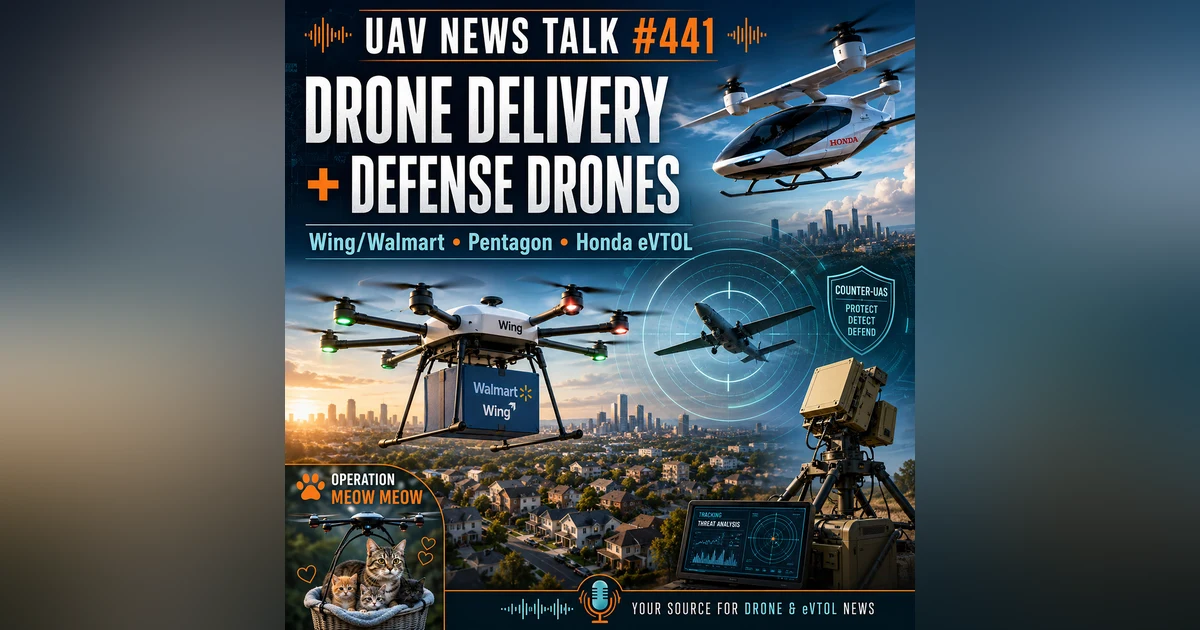
 In UAV News Talk #441, Max Trescott and David Vanderhoof cover the latest developments in drone delivery, defense drones, counter-drone systems, drone safety, police UAS operations, and eVTOL aircraft. The episode mixes major industry news with public-safety stories and a memorable animal-rescue ending.
The show opens with a lighthearted discussion about aviation companies with Chinese ownership, including Cirrus and Diamond, before turning to the week’s drone stories. The show's Video of the Week is an unusual police drone story from Louisiana. A man fleeing police reportedly ran into a swamp, where he was bitten by an alligator. Officers later used a drone to help locate him as he came out of the swamp. Max and David note that the suspect survived, which makes the story unusual, memorable, and darkly funny rather than tragic.
The first major industry story covers Wing and Walmart, which are expanding drone delivery into seven new markets. David highlights Philadelphia as especially interesting because it is a dense East Coast city, unlike some of the more spread-out markets where drone delivery has already been tested. Max notes that Wing and Walmart reportedly have approached one million deliveries, which suggests that drone delivery is moving beyond novelty and becoming part of some customers’ regular routines. They discuss the challenge of delivering to dense downtown areas, especially apartment buildings, while noting that suburbs in places like the San Francisco Bay Area may be easier to serve.
The episode then shifts to the Pentagon’s reported $54 billion drone arsenal effort. Max and David discuss how the war in Ukraine has shown the value of low-cost, disposable drones, and how the Pentagon is looking beyond traditional defense contractors. David notes that hobbyists and small drone makers may bring practical ideas to the table, while Max points out that the Pentagon is reportedly interested in hundreds of thousands of lower-cost drones. They also discuss companies such as Neros and the possibility that some small drone firms could become future billion-dollar defense contractors. David predicts that large defense companies may eventually acquire the smaller companies that prove successful.
Counter-drone technology is another major theme. Motorola’s $1.5 billion deal for Defend leads to a discussion of anti-drone systems for public safety, major sporting events, and protection against rogue operators. Max notes that counter-drone technology is a rapidly growing market, and David connects the topic to drone restrictions around major stadium events. They emphasize that flying drones over protected events is not only illegal but dangerous and likely to bring significant penalties.
Safety becomes one of the strongest segments of the episode when Max and David discuss Shield AI’s V-BAT and reported finger injuries involving rotating blades. David compares drone rotor hazards to helicopter rotors and aircraft propellers, while Max explains that drone operators can become complacent around low-probability, high-consequence hazards. Even smaller drones can have fast-spinning carbon-fiber propellers capable of causing serious injury. Max uses the story to call for stronger safety management thinking in the drone and eVTOL industries, including training, reporting, tracking incidents, and educating both employees and customers.
The public-safety drone segment focuses on Vancouver, British Columbia, where police are using Skydio drones linked to officer body cameras. David describes a feature that lets an officer tap a body camera three times to activate a drone response. Max calls the idea brilliant, since it could quickly provide aerial overwatch during a developing situation. They also discuss the broader value of drones for law enforcement, including the possibility that the presence of a drone alone might change the tone of an incident.
The eVTOL section begins with Honda’s first full-scale eVTOL flight. David compares Honda’s deliberate approach to the way the company entered the business-jet market with the HondaJet. Honda is moving carefully, testing first with a two-thirds scale model and now with a full-scale aircraft. Max notes Honda’s long-term approach and connects it to the company’s history of aviation innovation, including the HondaJet’s unusual over-the-wing engine design.
Next, Max and David discuss Volocopter’s effort to pursue a light-sport eVTOL aircraft. Max explains that most eVTOL stories focus on commuters, air taxis, and urban transportation, but Volocopter’s two-seat concept could be aimed at pilots who simply want to fly for fun. He explains the sport pilot/light-sport aircraft concept and why a recreational eVTOL could be exciting for pilots. David connects the idea to the Kitty Hawk Flyers at the American Helicopter Museum, which were also designed as lightweight recreational aircraft.
The episode also covers BETA Technologies and its conventional takeoff and landing electric aircraft strategy. Instead of focusing only on eVTOL, BETA is pursuing a CTOL aircraft that uses a runway. Max explains that this could offer a faster path to certification while using much of the same technology needed for a future eVTOL. David adds that CTOL electric aircraft could be useful for cargo operations, including operators such as FedEx and UPS, because runway-based aircraft may be more practical for larger payloads.
The show ends with a feel-good “Operation Meow Meow” story from Ukraine, where soldiers reportedly used a Vampire hexacopter drone to rescue a cat and four kittens from the front lines. Max connects it to the internet’s “cat distribution system,” joking that the next drone listeners see might be delivering a cat. It is a strong closing story because it provides a warm and memorable contrast to the episode’s earlier discussion of military drones and counter-drone threats.


