Drone Delivery, Flock Drones, eVTOL Forecasts, World Cup Drone Busts & Flying Into a Tornado


 RSS Feed
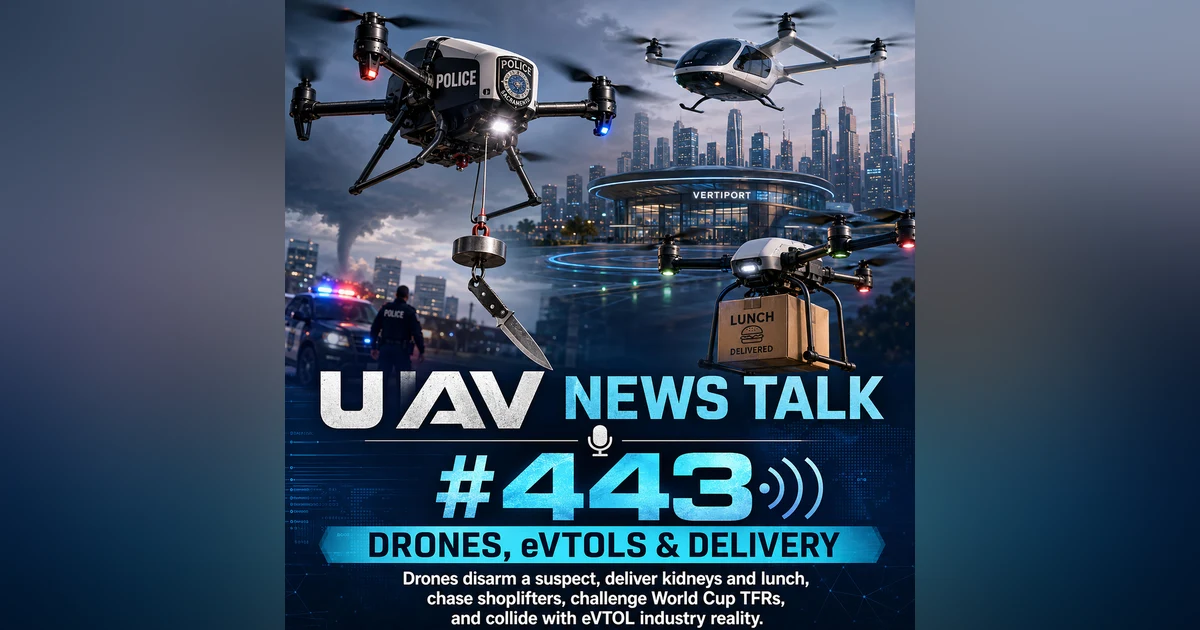
 Max Trescott and David Vanderhoof begin episode 443 of UAV News Talk with Video of the Week from Sacramento, California. The Sacramento Sheriff’s Office used a quadcopter with a high-powered magnet hanging below it to remove a knife from the hand of an armed suspect inside a house. Max notes that the suspect appeared unconscious and was not moving, but still had a knife gripped in his hand. The drone pilot flew through a cluttered house, attached the magnet to the knife, and then flew the knife back out. David points out that the flying was more impressive than the headline suggested, because the drone was carrying a swinging load through a confined indoor space. Max compares that to helicopters carrying sling loads, where oscillations can become dangerous if not controlled. David also raises a technical question: why didn’t the magnet interfere with the drone? Max suspects it was a permanent magnet rather than an electromagnet, which would simplify the setup.
The show then shifts to eVTOLs and the reality check facing the air taxi industry. A new new Valour Consultancy forecast projects a fleet of 6,824 eVTOL aircraft by 2050. Max and David contrast that with much larger earlier forecasts. Roland Berger previously projected 160,000 drones and air taxis by 2050. Eve Air Mobility projected 30,000 eVTOLs in service by 2045, carrying three billion passengers. Aviation Week Network had forecast 30,000 to 33,000 eVTOLs by 2050. Max says the much lower new number feels more grounded and compares the situation to the early-2000s very light jet market, when forecasts for thousands of personal jets never came close to reality. David agrees that a smaller 2030 fleet may be plausible, but he questions the steep growth assumptions beyond that.
Infrastructure and regulation remain major limiting factors. Max notes that many cities have plans for vertiports, but David emphasizes that building those facilities requires money, approvals, and political support. He expects local opposition from people who do not want buzzing eVTOLs landing near their homes. Certification of aircraft is only one piece of the problem; integrating them into cities and the national airspace system may be just as difficult.
The eVTOL discussion continues with growing eVTOL litigation. Max summarizes an article about electric air taxi companies getting stuck in court, including disputes involving Joby, Archer, Vertical Aerospace, and Wisk. Allegations include trade secret theft, patent infringement, supply chain concerns, and disputes over aircraft design. Max compares the situation to the historic Wright brothers versus Glenn Curtiss patent fight in early aviation. That dispute became so disruptive that, during World War I, the U.S. government pushed the industry toward a patent pool through the Manufacturers Aircraft Association. Max notes similar patterns in early automotive, sewing machine, motion picture, telephone, and radio industries. David says companies understandably want to protect intellectual property, but at some point they need to focus on building aircraft.
Next, David discusses the FAA breaking ground on a new facility at the Mike Monroney Aeronautical Center in Oklahoma City to support research, training, and operational analysis for advanced air mobility aircraft. Because Oklahoma City is already home to major FAA operations, including air traffic training, David sees this as a logical place for work on integrating UAS and eVTOL operations into the National Airspace System.
The drone news begins with unauthorized drone flights near World Cup-related TFRs. Max notes that despite warnings of potential $100,000 fines, the FBI’s Miami field office reported issuing tickets to 49 operators and seizing 54 drones in Florida, while more than 300 unauthorized drone flights were reported. David returns to his long-running distinction between people who are “dumb” and people who are “stupid”: some may not have known better, while others may have knowingly ignored the rules. Max suspects many were hobbyists who simply thought it would be fun to fly near a major event.
NASA’s test using a drone to transport a human kidney gets special attention from David, who received a kidney transplant in November. He says medical transport is one of the strongest drone use cases because organs and medicines are time-sensitive and often light enough to move by UAS. Max clarifies that the kidney in this test was non-viable and not intended for transplant, but says the demonstration shows how drones could be used for real organ transport in the future. Both encourage listeners to register now to become an organ donors at RegisterMe.org.
The episode also covers a dramatic video of a drone flying into or near a tornado. David cautions that people should not fly drones during tornado warnings and should seek shelter instead. Max notices branding on the side of the drone that appears to connect it to a generator company, and David suggests the stunt may have had a marketing angle. They both discourage the behavior, noting that a drone could become dangerous debris in severe weather.
Max then explains how Flock Safety, known for license plate recognition cameras, is adding drones after acquiring Aerodome. He sees a logical connection: if a camera detects a stolen car, a drone could launch quickly and help locate it before police arrive. David agrees the speed and overhead view are valuable but raises questions about privacy, data access, maintenance, battery readiness, and dock infrastructure.
Another police drone story comes from Irvine, California, where a drone helped locate a shoplifter hiding in the bed of a truck under tarps. David compares it to a helicopter chase but at lower cost and with faster response. Max jokes about the future of Southern California car chases being covered by drones, and David suggests a drone swarm would provide multiple camera angles.
The episode wraps with a lighter story from Ohio, where Dexta and All the Best Delicatessen completed the state’s first commercial food drone delivery: a boxed lunch, including a pickle, flown about 1.5 miles to a residential site and back. Max and David discuss whether drone food delivery might cost less than car-based delivery and whether the lack of tipping could offset some fees. The mention of cheesesteaks pushes Max into memories of college in the Philadelphia area.


