Archer Aviation Goes Beyond eVTOL: Boeing, Wisk, Insitu & SkyGrid Deep Dive


 RSS Feed
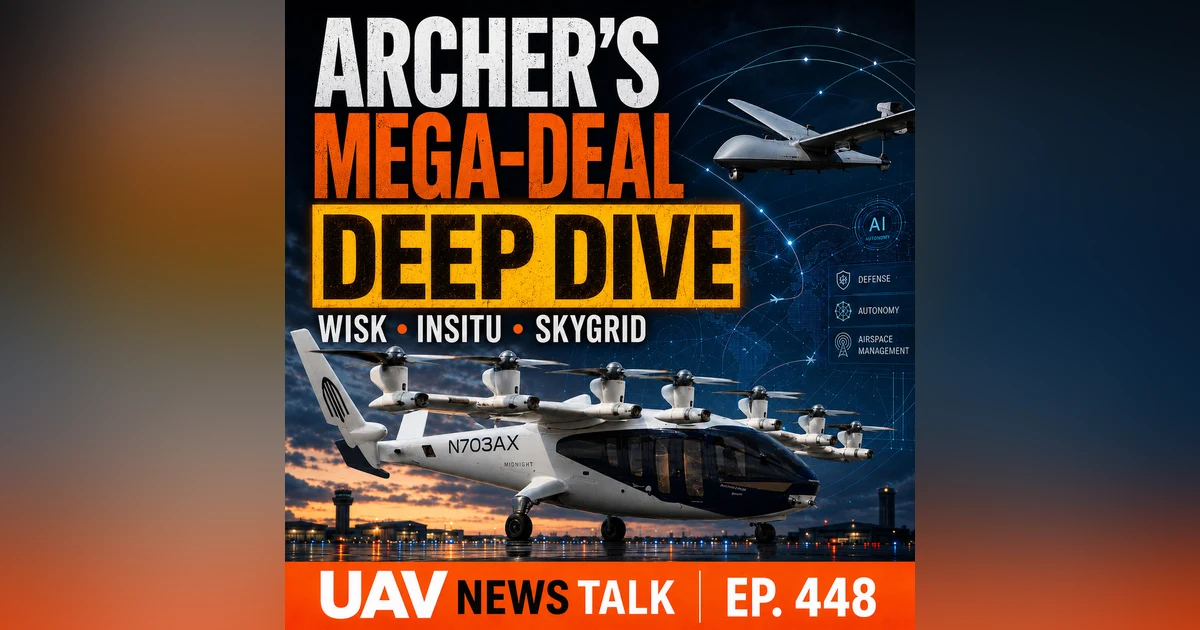
 A breaking announcement from Archer Aviation and Boeing was big enough to blow up the normal rundown for UAV News Talk #448. Instead of covering seven or eight separate drone and eVTOL stories, Max Trescott and David Vanderhoof devote the entire episode to Archer’s agreement to acquire three Boeing businesses: Wisk Aero, Insitu and SkyGrid.
The transaction could fundamentally change how Archer Aviation should be viewed. Until recently, Archer was known primarily as the developer of Midnight, its piloted four-passenger eVTOL. The Boeing transaction could give Archer autonomous passenger-aircraft technology, an established military UAS operation, airspace-management software, extensive autonomy expertise and a huge amount of operational experience and data.
Max and David begin by examining the three companies Archer is acquiring. Wisk has spent years developing autonomous electric vertical takeoff and landing aircraft and is currently working on its sixth-generation aircraft. SkyGrid adds airspace-management and autonomy-related capabilities.
But Insitu may be the real prize.
The Boeing subsidiary is an established military UAS manufacturer whose aircraft include ScanEagle, Integrator and the RQ-21 Blackjack. More than 3,500 Insitu UAS have reportedly been fielded across roughly 35 countries, and the company has accumulated approximately 1.6 million operational flight hours. Archer says Insitu generates more than $200 million in annual revenue and is profitable.
That revenue creates an intriguing contrast with Archer’s existing business. Max compares Archer’s recent quarterly results, noting Q1 revenue of only $1.6 million against roughly $256 million in expenses and Q2 revenue of approximately $5 million against $284 million in expenses. Archer has nevertheless demonstrated an extraordinary ability to raise capital and maintain substantial liquidity while funding development.
Adding Insitu therefore does something important immediately: it gives Archer an established, revenue-producing defense business while Midnight certification and commercialization continue.
The structure of the Boeing transaction is equally fascinating. Archer is not simply handing Boeing a large cash payment. Boeing will instead become a significant Archer shareholder, receiving equity equal to approximately 19.75% of Archer’s pre-closing Class A share count, along with warrants, potential future investment rights and a board nomination right under specified circumstances. Boeing and Archer will also cross-license certain technology.
Max and David discuss whether Boeing is really exiting these technologies at all—or simply moving the businesses out of Boeing while retaining financial exposure and access to some of their technological upside.
One of the biggest unanswered questions involves Wisk.
Does Archer really need two eVTOL programs? Midnight is designed around a pilot, while Wisk Gen 6 is being developed as an autonomous passenger aircraft. Max speculates that Wisk’s engineering talent, autonomy expertise and intellectual property may ultimately prove more valuable to Archer than maintaining Gen 6 indefinitely as a separate aircraft program. Some of those resources could potentially migrate toward Midnight, Archer Defense or Archer’s work with Anduril.
The conversation then turns to ZEE, Archer’s aviation-specific AI foundation model. ZEE is designed to ingest information including ADS-B traffic, ATC communications, airport and mapping data, terrain, weather and aircraft-state data. Archer has demonstrated the technology predicting possible future trajectories of aircraft moving around airport surfaces.
Combined with SkyGrid, Wisk and Insitu, ZEE raises a much bigger strategic possibility. Archer may be attempting to build not merely aircraft, but an entire ecosystem around autonomous aviation: AI that understands and predicts the operating environment, airspace software that helps manage it, autonomous-flight technology from Wisk, and proven UAS platforms and operational experience from Insitu.
That ambition also creates substantial risk.
Mergers create organizational upheaval even when businesses are mature and closely related. Archer will potentially have to integrate overlapping HR, accounting, marketing, management and other corporate functions while deciding how engineering resources and individual programs fit together. Max and David discuss whether layoffs will be limited because these remain rapidly growing technology sectors, with employees more likely in many cases to be reassigned as priorities and reporting structures change.
The transaction also appears to signal that the long-predicted consolidation of the eVTOL industry is beginning. Hundreds of companies have pursued electric and advanced air-mobility aircraft, but Max has long expected the field eventually to shrink to a handful of major players. Archer’s ability to raise billions of dollars and now absorb valuable aerospace businesses suggests it intends to be one of those survivors.
That inevitably raises the question of Joby Aviation. Joby has also expanded beyond eVTOL development through Blade and more recently through military work involving L3Harris and the Department of Defense. Max and David see the possibility of Archer and Joby evolving into two major competitors resembling Boeing and Airbus, with additional players eventually emerging.
The episode closes with three possible futures for Archer: this transaction becomes a masterstroke that creates a successful diversified aviation company; it becomes a technology roll-up in which programs such as Wisk Gen 6 eventually disappear; or Archer discovers that it has attempted too much, too quickly.
Max comes down strongly on the first possibility. David agrees that the combination has enormous potential while emphasizing that the real test will be how Archer manages the businesses, technologies and military programs it is about to inherit.
Either way, one message from this deal seems clear: Archer Aviation is no longer just an eVTOL story.


