Uber & Zipline Target 1 Million Drone Deliveries a Day + DARPA’s Extreme-Lift Drone Challenge


 RSS Feed
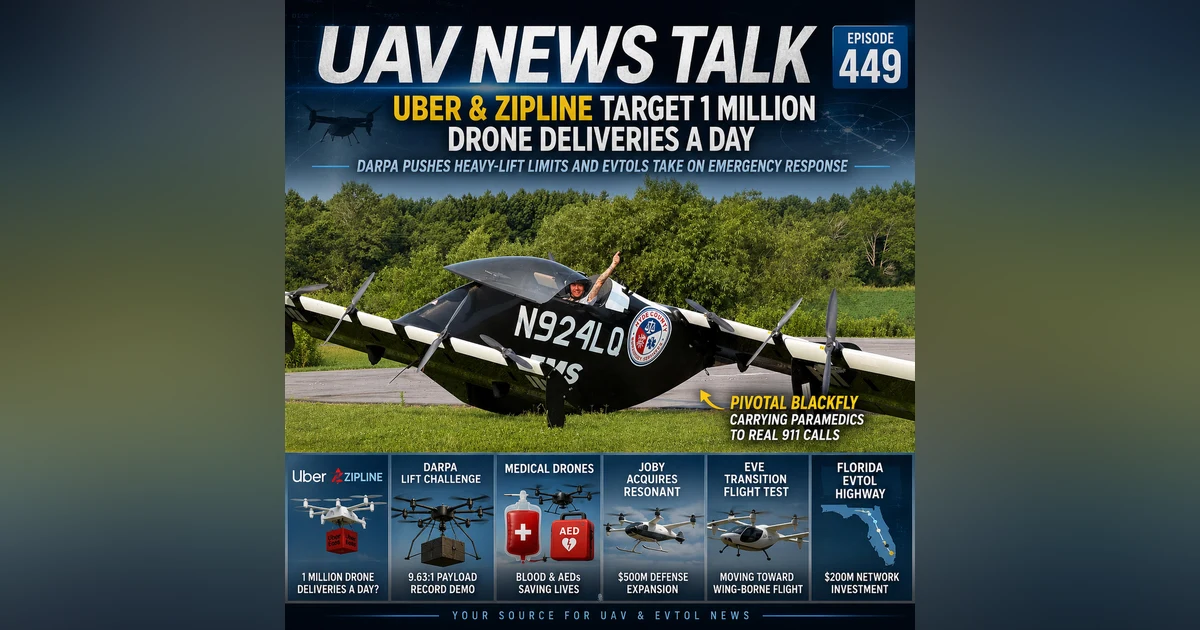
 Uber is doubling down on drone delivery, DARPA challenged engineers to create extraordinarily capable heavy-lift drones, and drones and eVTOLs are increasingly being used to get lifesaving medical help to patients faster. Max Trescott and David Vanderhoof cover those stories and much more in UAV News Talk #449.
Video of the week: Sports camera drone discovers that hurdles really are obstacles
The episode begins with a drone video that demonstrates what can happen when an operator gets just a little too ambitious. During the European track-and-field championships, a camera drone started flying along the course. After successfully passing over the hurdles, the operator apparently decided to make the shot more dramatic by flying through them. That worked—until it didn't.
Uber and Zipline then provide one of the week's biggest commercial drone stories. Uber has announced a strategic partnership with Zipline with an ambitious long-term target of one million drone deliveries per day. But Uber's involvement with drone delivery isn't new. Max traces the company's history back to 2018 and 2019, when Uber worked on food-delivery experiments in San Diego and even developed its own six-rotor delivery drone. Uber later sold its aviation operation to Joby Aviation. More recently, it returned to drone delivery through partnerships with companies including Manna and Flytrex.
The Zipline deal suggests Uber may have settled on a very different strategy: rather than develop and operate drones itself, it can provide the enormous Uber Eats marketplace while specialized drone companies provide the aircraft and delivery infrastructure.
Meanwhile, Washington continues reshaping the U.S. drone industry. New tariffs could dramatically increase the cost of certain foreign-made drones and components. Max and David discuss what that could mean for DJI and for American commercial drone operators who currently depend heavily on foreign technology.
DARPA's Lift Challenge produced some of the episode's most interesting engineering. The Defense Advanced Research Projects Agency challenged competitors to develop aircraft weighing less than 55 pounds capable of carrying extremely large payloads.
Of 132 invited teams, 76 checked in, 62 cleared safety inspections, and only five ultimately completed scored runs. AVIDrone won with an impressive 3.84-to-1 payload-to-weight ratio, narrowly missing DARPA's 4-to-1 target.
But perhaps the most fascinating aircraft came from DefendTex. Its extremely lightweight design demonstrated an extraordinary 9.63-to-1 payload-to-weight ratio. It couldn't complete a scored competition run, but DARPA nevertheless awarded the team $500,000 for its promising technology.
Drones are also increasingly becoming part of emergency medical response. Archer First Response Systems—unrelated to eVTOL manufacturer Archer Aviation—is working on delivering whole blood by drone to emergency scenes in Florida, potentially getting critical supplies to first responders within minutes.
An even more dramatic example comes from Sweden, where an Everdrone aircraft carrying an automated external defibrillator reached a cardiac-arrest patient ahead of the ambulance. A bystander used the AED with assistance from the emergency dispatcher and was able to restart the man's heart before conventional responders arrived.
The episode then turns to eVTOLs.
Just one day after the major Archer Aviation transaction discussed in UAV News Talk #448, Joby Aviation announced a roughly $500 million acquisition of defense technology company Resonant Sciences. The deal gives Joby a substantial existing defense business and provides another example of leading eVTOL companies developing military businesses alongside their future commercial air-taxi operations.
Eve Air Mobility has also reached an important flight-test milestone by beginning the transition toward wing-borne flight. Its prototype activated its rear pusher propeller and accelerated to approximately 30 knots while testing the complex transition between vertical lift and conventional forward flight.
Perhaps the most intriguing eVTOL application, though, comes from rural North Carolina.
Hyde County has used Pivotal's BlackFly to send a flight-trained paramedic directly to actual 911 calls. The small single-seat aircraft can land in considerably less space than a conventional medical helicopter, and on two real emergency calls the airborne paramedic reportedly arrived about 20 minutes ahead of the ground ambulance.
That could point toward an entirely different near-term role for eVTOL technology. Instead of immediately trying to transport patients, a small aircraft could rapidly move one highly trained medical professional and critical equipment across rural areas where roads and geography make ambulance response slow.
Finally, Florida is putting substantial money behind advanced air mobility infrastructure. Approximately $200 million originally intended for electric-car charging infrastructure is being redirected toward a network of eVTOL landing and charging sites around the state.


