11,000-Drone Spectacular, DoorDash Delivery Drones & Skydio's New Fixed-Wing Aircraft


 RSS Feed
 This week on UAV News Talk, Max Trescott and David Vanderhoof explore a spectacular record-breaking drone show, DoorDash's new autonomous delivery aircraft, Skydio's unconventional fixed-wing drone, a significant legal victory involving local drone regulations, and major developments in electric aviation—including a $116.9 million verdict against Joby Aviation.
An 11,000-Drone Show Sets a Stunning Record
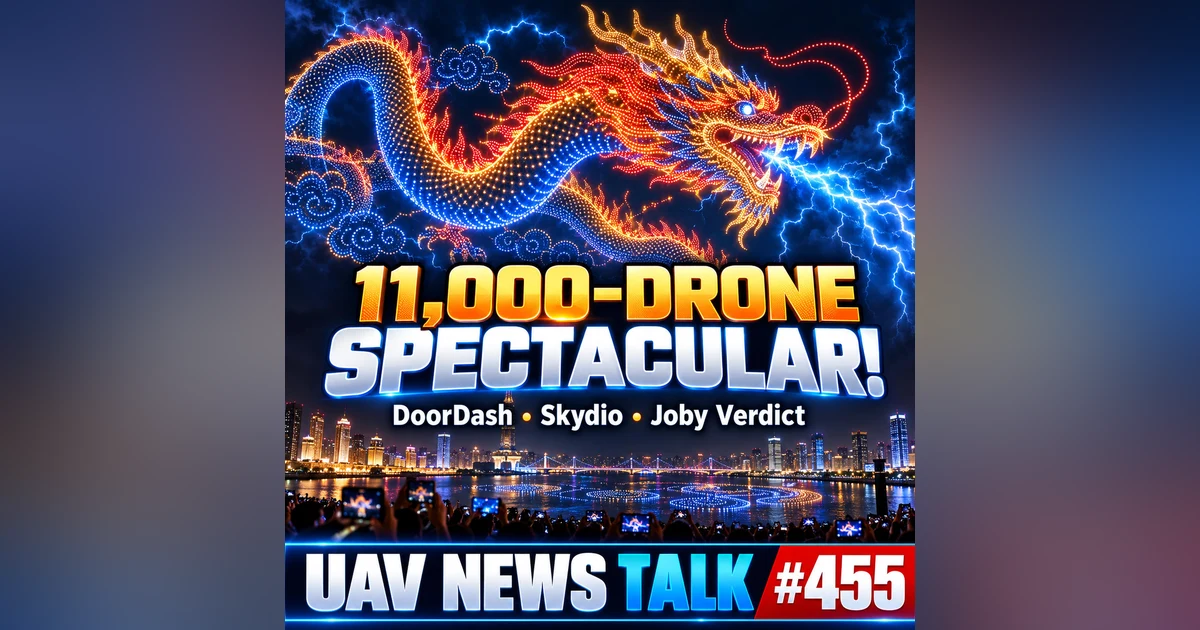
The episode begins with what Max calls the most impressive drone show he's ever seen, which is the Video of the Week. Featuring more than 11,000 drones, the performance creates extraordinary three-dimensional mythical creatures, including a massive dragon complete with dramatic lightning effects. The dragon alone uses 10,183 drones, earning a Guinness World Record for the largest aerial display of a mythical creature.
The show demonstrates the remarkable evolution of coordinated drone entertainment, with sophisticated programming producing depth, movement, and dramatic visual effects. Max and David also consider the economics of an operation this large. At an estimated $1,000 per drone, the hardware alone could represent an investment exceeding $11 million.
Interestingly, the performance is associated with Sky Elements, a company previously discussed on the podcast following a drone-show accident in Florida. The hosts also highlight footage showing the enormous fleet launching into the sky.
DoorDash Introduces Its Own Autonomous Delivery Drone
DoorDash is expanding beyond conventional food delivery with DoorDash Air, a purpose-built autonomous aircraft designed to transport restaurant orders directly to customers. Initial operations are planned for Northern California, with participating restaurant brands including Chipotle and Popeyes.
Unlike some existing drone delivery arrangements, DoorDash is developing its own aircraft and delivery system. The company says it is concentrating on the difficult first and last 10 feet of delivery, including collecting orders from merchants and delivering them to customers.
One particularly interesting feature is the aircraft's relatively large, slowly rotating propellers, designed to reduce irritating high-frequency noise. David notes that the drone appears considerably larger than some competing aircraft, potentially creating challenges near restaurants and residential properties. Max questions whether the quieter experience results from lower overall sound levels or simply a shift toward frequencies people find less objectionable.
Skydio Reveals an Unconventional Fixed-Wing Drone
Skydio introduces a new family of aircraft, including its F10 Light Runner, an unusual asymmetrical fixed-wing drone capable of speeds approaching 100 mph.
Designed for emergency response, search and rescue, and infrastructure inspection, the aircraft could reach distant incidents rapidly while providing live aerial imagery to responders still traveling to the scene.
Its offset fuselage attracts particular attention. David compares the design to the German Blohm & Voss BV 141 reconnaissance aircraft from World War II, which also employed an asymmetrical configuration.
Equally innovative is Skydio's docking system, designed to accommodate as many as five aircraft. A suction-based robotic gripper launches and recovers drones without requiring personnel at the launch site. Skydio calls the technology robotic takeoff and landing, or RTOL.
With customers reportedly conducting two million missions annually, more than half involving docking systems, Skydio brings considerable operational experience to this ambitious concept.
New Jersey Drone Ban Faces Federal Preemption
A federal court ruling involving Lodi, New Jersey, highlights continuing conflicts between municipal drone ordinances and FAA authority.
Lodi adopted restrictions that effectively prohibited drones from operating below 400 feet, despite FAA rules generally requiring small drones to remain at or below that altitude. Penalties included escalating fines and potentially jail time for repeated offenses.
A drone pilot challenged the ordinance without an attorney. The court found the challenged restrictions preempted by federal law, although the pilot did not receive all the relief he sought.
The case underscores the continuing uncertainty surrounding local efforts to regulate drone operations and the boundaries of federal airspace authority.
BETA Demonstrates Electric Aviation for Rural Emergency Services
BETA Technologies brings its conventional-takeoff electric aircraft to Washington County, Texas, as part of an initiative exploring advanced aviation technology for emergency services.
The county's EMS system handles more than 7,000 calls annually across approximately 700 square miles. Electric aircraft could supplement existing helicopters and ground vehicles by transporting medical personnel, emergency supplies, and disaster-response equipment.
Max and David explain that BETA develops both conventional-takeoff and vertical-takeoff configurations, with related airframe designs serving different operational requirements.
DTA Aircraft Partners with Embry-Riddle
DTA Aircraft is working with Embry-Riddle Aeronautical University to advance its JP-1, a two-seat hybrid-electric personal eVTOL aircraft.
Introduced at AirVenture, where Max saw the aircraft and spoke with its developers, the JP-1 carries a reported price of $385,000. Advertised specifications include a two-hour endurance, 180-mile range with two occupants, and a maximum speed of 90 mph.
The partnership gives engineering students opportunities to participate in real-world aircraft development while providing DTA with academic resources and technical expertise. Max emphasizes the tremendous educational value of hands-on engineering experience.
Joby Faces a $116.9 Million Trade-Secret Verdict
Finally, a U.S. jury awards aircraft component manufacturer Aerosonic approximately $116.9 million after finding that Joby Aviation breached a nondisclosure agreement and willfully misappropriated trade secrets involving aircraft data-probe technology.
Joby disputes the verdict and intends to pursue post-trial and appellate remedies.
The case joins other intellectual-property disputes involving Joby, Archer Aviation, Wisk, and Vertical Aerospace. Max observes that similar legal battles surrounded the early airplane industry more than a century ago, suggesting that these conflicts may be another indication of an emerging aviation sector working through rapid technological development and intense competition.


