Thermal Drone Pet Rescue, Drone Business & Orlando Drone Show Crash


 RSS Feed
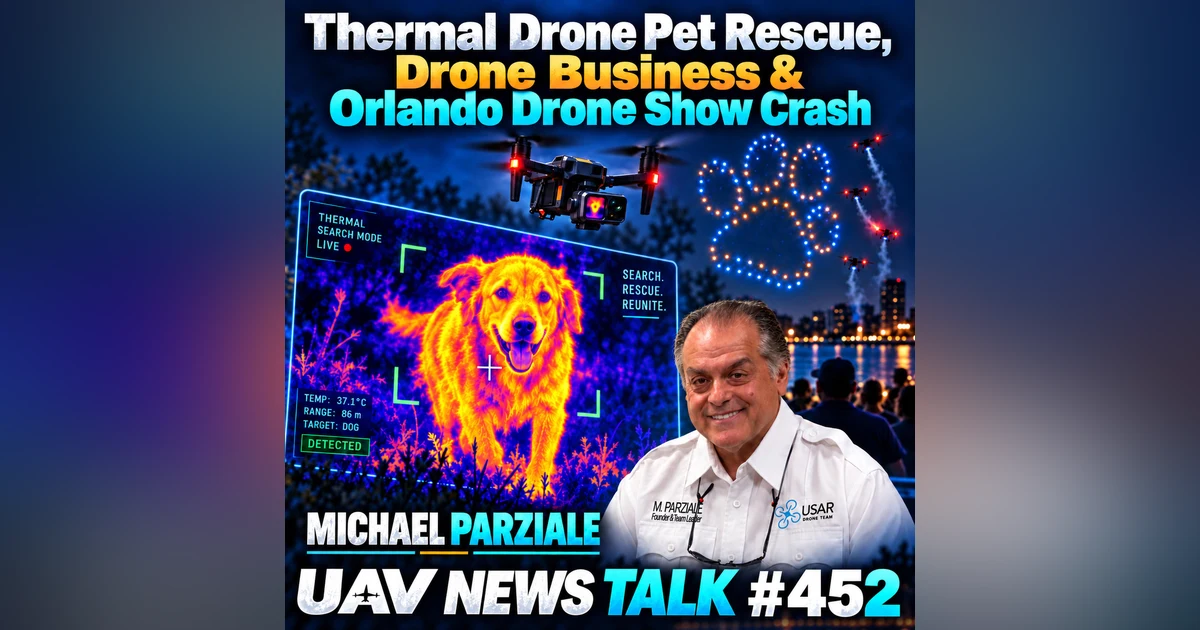
 What can you actually do with a commercial drone business? Michael Parziale's answer seems to be: just about anything.
Michael is the founder and team leader of the U.S.A.R. Drone Team, and his path into commercial drones began almost by accident. A longtime manned-aircraft pilot, he temporarily couldn't fly because of a medical issue and bought a small DJI drone after trying one owned by a friend.
That eventually led him to professional thermal drones—and to search and rescue.
Michael initially developed a system for using a drone to deliver a personal flotation device directly into the hands of someone in the water. Then a local pastor asked whether his thermal drone could help find a man who had been missing for three days. Michael says he located the man in a swamp in just over an hour.
Soon people began asking whether the same technology could locate lost pets. Michael says he's now found more than 150 dogs and cats, and pet searches have become one of the most visible parts of his business.
He takes us through a search from a drone pilot's perspective. Searches usually begin at the pet's home or last confirmed location and expand outward. Michael generally hand-flies rather than using automated waypoint missions, moving slowly and methodically while watching the thermal image.
Most searches occur at night, when the cooler background makes animals easier to see with thermal imaging. Once he spots something that looks like a dog or cat, he switches to the visible-light camera and a spotlight. The owner is often standing beside him and can determine whether the animal is actually the missing pet.
Michael also talks about the economics. A three-hour pet search typically starts around $650, plus travel when necessary. And professional equipment isn't cheap. A high-end drone, thermal payload, spotlight, batteries, and supporting hardware can represent an investment of tens of thousands of dollars.
But lost pets are just one branch of Michael's operation. He's trained police officers to fly drones, worked with agricultural spraying systems, conducted mapping missions, developed a youth drone school, and helps veterans learn skills that can lead to UAV careers.
Now he's making an even bigger bet on drone light shows. Michael has obtained an FAA waiver for swarm operations and has purchased more than 100 show drones, with plans to expand toward 300. He explains that buying the aircraft is only the beginning: operators also need programming, insurance, trailers, crews, transportation, setup time, and substantial capital.
And that brings us to the other major story in this episode.
The NTSB has just released its final report on the December 2024 holiday drone show at Lake Eola in Orlando, Florida. All 500 drones launched, but almost immediately some failed to maintain their intended separation. Drones collided in midair, lost control, and fell toward the ground and spectators.
The NTSB found several seemingly small setup errors that combined into a much larger failure.
The uploaded show-center position was about five meters from where it should have been. That caused the software to assign drones to incorrect flight paths. The show heading was also entered about seven degrees off, shifting the show approximately 59 feet toward the audience.
Then there was another programming inconsistency: when the show-center position was updated, only 498 of the 500 drones were selected, leaving two aircraft with different show-center information.
The geofence configuration added another problem. Company policy had recently changed the spacing between the soft and hard geofences, but the computer being used for the Orlando show still had the old setting. Most importantly, the company did not have a formal independent verification procedure requiring another pilot or manager to check these critical parameters before launch.
The NTSB determined that the probable cause was the remote pilot-in-command's failure to properly locate the drone-show center over the physical aircraft. The incorrect heading and geofence were contributing factors, along with the operator's lack of oversight that allowed multiple individual errors to go undetected.
The consequences were serious. The report accounts for roughly four dozen affected drones. One entered the spectator area and struck a seven-year-old boy in the face and chest. The NTSB classified his injuries as serious, and his family later said he required emergency open-heart surgery.
Since the accident, the operator has made significant changes, including requiring two Part 107 pilots, using a signed paper checklist, requiring shows to be ready at least 15 minutes before launch, checking critical parameters before every show, and maintaining at least a 155-foot safety buffer between the geofence and spectators.
Together, Michael's story and the Orlando accident show both sides of a rapidly growing industry: drones can create businesses and perform tasks that weren't practical a few years ago, but increasingly sophisticated operations also demand increasingly sophisticated procedures, training, and oversight.
Max and David also discuss a Zipline Drone that came down under a parachute, and a Drone possession ban in Beijing.


