Drone Delivery Explodes: Amazon Targets 500 Locations as New Drone Fees Spread



 RSS Feed
 Drone delivery has been promising to transform last-mile logistics for years, but the industry may finally be approaching the point where the technology moves from limited trials to widespread deployment.
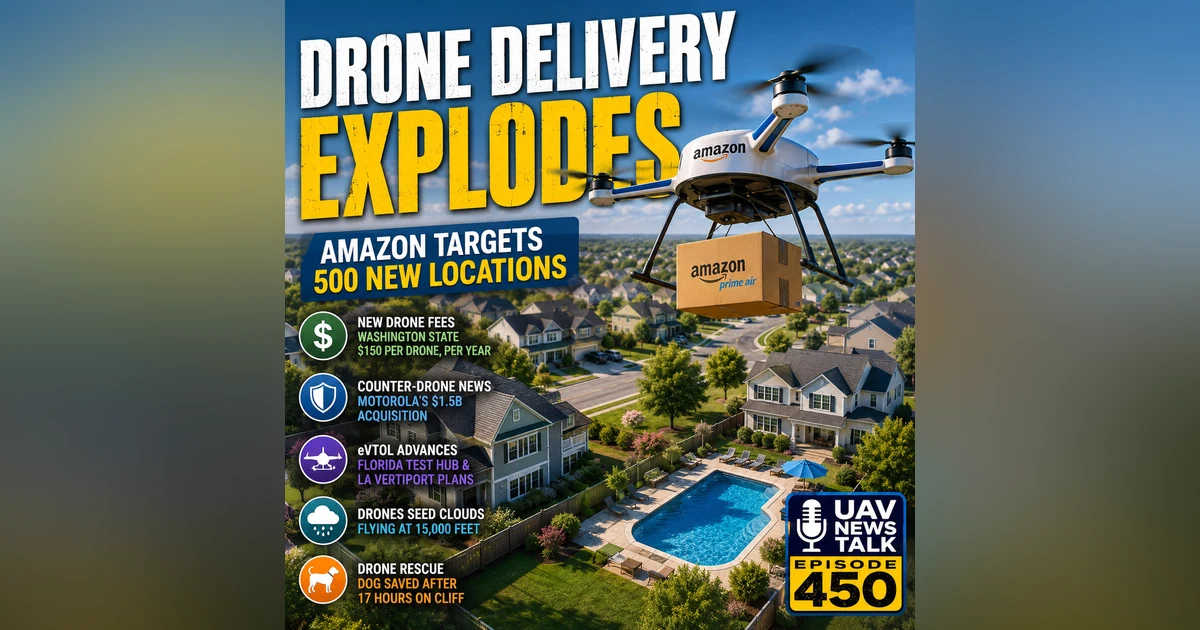
In episode 450 of UAV News Talk, Max Trescott and David Vanderhoof examine Amazon’s plans to dramatically expand drone delivery into hundreds of additional locations. The company’s proposed expansion comes as other major players are scaling up as well. Alphabet subsidiary Wing plans hundreds of drone delivery locations, while Walmart is already providing drone delivery from dozens of stores across several states.
Video of the Week: Epic Amazon Drone Delivery Fail
Max believes the industry may have reached an inflection point, with drone delivery potentially becoming one of the biggest UAV stories of 2027. The discussion also examines where that growth is most likely to occur. Suburban neighborhoods offer relatively open operating environments compared with downtown areas, major airports, skyscrapers, and complicated airspace such as the Washington, D.C. region.
The episode starts with a humorous reminder that drone delivery still has a few problems to solve. Videos circulating online show delivery packages ending up in swimming pools—including one apparently pushed into the water by rotor downwash. Another delivery demonstrates an important safety feature when the drone repeatedly refuses to descend while a person is standing beneath it.
As commercial drone fleets grow, however, another challenge is emerging: state fees.
Washington State is increasing the cost of operating commercial drones. A previous $15 annual drone registration fee has doubled to $30, and a new $120 aircraft excise tax brings the total annual cost to approximately $150 per drone. The fees are also scheduled to increase over time.
For a small Part 107 operator with one aircraft, that may be manageable. For a business operating ten drones, however, the cost becomes $1,500 per year before the aircraft generate any revenue. For future delivery networks operating hundreds or thousands of drones, varying state registration and tax requirements could become a significant administrative and financial burden.
Max notes that Washington is not alone. Minnesota and Utah also impose state requirements affecting commercial drone operators, while some states have specialized fees for particular operations such as agricultural application. The result could eventually become a patchwork of state-level requirements layered on top of federal FAA registration.
The episode also looks at significant developments in advanced air mobility.
Florida’s SunTrax facility, located between Tampa and Orlando, is being developed into a major testing environment for eVTOL aircraft. The 775-acre campus includes extensive infrastructure and room not only for flight testing but also for manufacturing and other aviation businesses. eVTOL developer AIR plans to establish its U.S. headquarters and a production and flight hub there.
Across the country, Los Angeles is preparing for another important advanced-air-mobility project. Plans call for a vertiport at LA Live, placing eVTOL service in the heart of the downtown entertainment and convention district. Archer air taxis could eventually make trips that take 10 to 20 minutes by air but potentially much longer in Los Angeles traffic.
Max and David discuss whether downtown-to-downtown transportation could actually prove more practical for eVTOLs than airport service. Passengers traveling to airports frequently carry substantial luggage, consuming both payload capacity and storage space. Short urban trips to entertainment, business, or convention destinations could avoid much of that problem.
Another eVTOL concept takes personal transportation in a very different direction. CoolFly is proposing a single-person aircraft in which the occupant travels while standing rather than sitting. Max and David question how large a market might exist for an airborne vehicle that resembles, at least conceptually, a flying Segway.
Counter-drone technology is another major theme in the episode.
The Pentagon is preparing evaluations of directed-energy counter-UAS prototypes, including technologies that use electromagnetic energy rather than relying solely on conventional weapons.
Meanwhile, Motorola Solutions has completed its $1.5 billion acquisition of Defend Solutions. Its counter-drone technology detects radio-frequency-controlled drones and can take control of them, directing them to a safe landing location. The acquisition complements Motorola’s growing business supplying technology to law enforcement agencies, including drones used in Drone as First Responder operations.
The hosts also discuss the limitation of RF-based counter-drone systems: they cannot necessarily defeat aircraft controlled through methods such as fiber-optic links, demonstrating why future counter-UAS defenses may need to employ several different detection and defeat technologies.
In another unusual UAV application, drones are being used for cloud seeding. Aircraft weighing roughly 50 pounds can operate at altitudes around 15,000 feet while dispersing silver iodide to encourage precipitation. Max contrasts the approach with older cloud-seeding techniques that required pilots to fly crewed airplanes in hazardous weather and icing conditions while carrying burning flares.
Finally, the episode closes with a reminder of the positive ways drones can be used every day.
When a 30-pound dog named Carl disappeared on a farm near Charlotte, Tennessee, his owner spent 17 hours searching for him. A neighbor’s son eventually launched a drone and found Carl stranded on a cliff ledge that could not be seen from above. Local firefighters responded with rappelling equipment, descended the cliff and successfully rescued him.
It’s an appropriate ending for episode 450: from package delivery and air taxis to counter-UAS warfare, weather modification and animal rescue, drones continue finding applications that would have been difficult to imagine when this podcast began.


