DoorDash Air Takes Flight as Motorola Enters Police Drone Market


 RSS Feed
 Max begins with an AirVenture report after his first visit to Oshkosh in nine years. One of his main destinations was the new Vertical Lift Center, where he saw several aircraft that illustrate how quickly the eVTOL industry is developing. Joby occupied a prominent location near the entrance, giving Max his first opportunity to examine the company’s aircraft up close.
Video of the Week: NYPD drone captures teen subway surfers on video
Buy an AED (automated external defibrillator) for your home.
Inside the Vertical Lift Center, Max examined the DTA JP1, a two-seat personal eVTOL with eight propellers. Its most notable feature is its hybrid-electric propulsion system. Gasoline power is used during the most demanding portions of flight, while electric power can be used after takeoff. The company claims approximately two hours of flight at 90 miles per hour, and the aircraft includes a parachute designed to deploy automatically following the failure of two rotors. Max and David see hybrid propulsion as an important compromise between battery limitations and the desire for electrically driven aircraft.
Max also met SkyFly founder Michael Douglas and examined the company’s winged eVTOL. The partial wing is intended to improve efficiency and endurance compared with aircraft that rely entirely on powered lift. Douglas said the company had 61 orders and was watching the final MOSAIC rule for its effect on certification. At Zipline’s exhibit, Max handled the delivery pod and learned how opposing fans steer it as it descends on a tether from a drone flying about 300 feet above the ground. Zipline says its system can operate in winds up to 20 knots, gusting to 29 knots, and in rainfall of up to two inches per hour. Max’s overall AirVenture conclusion is that eVTOLs and advanced delivery systems are becoming practical products rather than distant concepts.
The first major news story concerns Archer and Anduril’s Thunder, a military aircraft derived from Archer’s electric air-taxi technology. The project reflects a broader trend in which emerging aviation companies pursue military contracts to support development and accelerate deployment.
The military stories also show how civil aircraft technology can be adapted for cargo, evacuation, and autonomous missions while manufacturers await broader commercial demand to emerge.
BETA Technologies is following a similar path with the MV250, an autonomous hybrid-electric aircraft intended for military logistics and medical evacuation. It can carry a 2,000-pound payload, has a tactical range of 250 nautical miles, and a repositioning range of 1,300 nautical miles. Its long-range capability could allow it to deploy itself rather than occupy space aboard a transport aircraft.
Joby and Virgin Atlantic have finalized an agreement to bring electric air-taxi service to the United Kingdom, with proposed operations around London and Manchester. Electra plans a 96-acre Ohio facility capable of producing as many as 800 hybrid-electric EL9 aircraft per year and potentially creating 1,975 jobs.
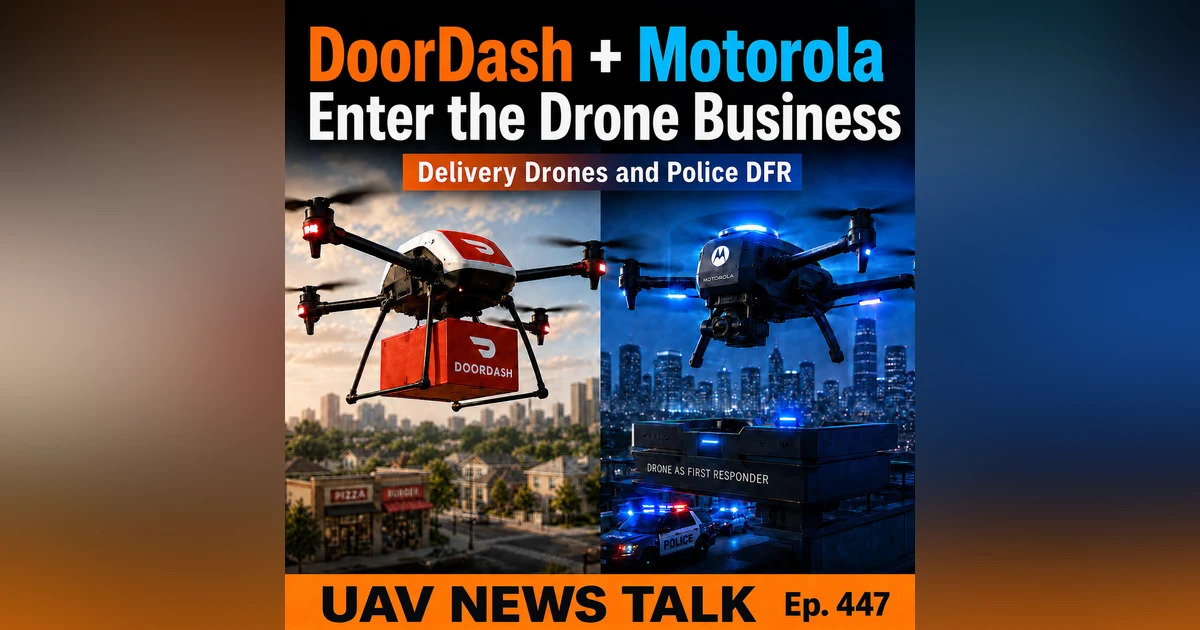
The centerpiece of the drone news is DoorDash’s move into aircraft development and operation. The company has received an FAA Part 135 air-carrier certificate and created DoorDash Labs to build its own delivery drones. DoorDash already possesses advantages that most drone manufacturers lack: relationships with hundreds of thousands of merchants, a vast customer base, logistics experience, and an established ordering platform. Rather than merely partnering with an aviation company, DoorDash is becoming vertically integrated.
DoorDash says drones will complement rather than replace its human delivery workers. The company envisions aircraft handling inefficient three-to-five-mile trips while Dashers focus on shorter, clustered deliveries near restaurants and stores. Max nevertheless expects some worker displacement. He also notes that DoorDash has experimented with shared and “ghost” kitchen facilities, suggesting it may eventually control more of the food-production and delivery chain. His prediction is that DoorDash could become a dominant force in U.S. drone delivery.
Federal policy may help accelerate that transition. The FAA has established a nationwide environmental path that may reduce the need for separate environmental reviews in every new delivery location. The FCC has extended certain drone supply-chain exemptions through 2028 while considering restrictions on imported military-grade systems.
Another major established company entering drones is Motorola. Plano approved the purchase of a police drone system from the company, which has supplied public-safety communications equipment for generations. Max argues that Motorola’s trusted relationships with police and fire departments could make it a formidable competitor in the Drone as First Responder market. Agencies may feel more comfortable buying an integrated drone solution from a familiar supplier than from a less established aviation startup.
The episode closes with a positive use of drone technology. James City County, Virginia, is testing drone delivery of automated external defibrillators within five miles of a fire station in Toano. The aircraft can carry an AED to a suspected cardiac-arrest patient while conventional responders are still traveling. Because modern AEDs provide spoken instructions, a bystander can begin treatment before paramedics arrive. Max and David believe the concept could save lives and deserves consideration by emergency-service agencies nationwide.
Buy an AED (automated external defibrillator) for your home.


