Joby Toyota eVTOL Deal, Archer Salinas Factory, Pentagon Drone Czar & Disaster Response Drones


 RSS Feed
 In episode 444 of UAV News Talk, Max Trescott and David VanderHoof open with a major programming announcement: the show is returning to a weekly schedule. After originally slowing down to a less frequent cadence, Max and David say there is simply too much happening in the drone, UAV, UAS, and eVTOL worlds to stay away for long.
Video of the Week: Max taxiing by the Archer Midnight during testing at Salinas, CA.
The first major story focuses on how aerial robotics supported Venezuela after two devastating earthquakes. Max and David discuss the many roles drones can play in disaster response, from rapid assessment of transportation infrastructure to search and rescue support. Drones were used to inspect older bridges, coordinate rescue operations, search for survivors using thermal imaging, deliver medical supplies to inaccessible areas, relay communications, and support structural integrity scanning with LIDAR. They also talk about environmental hazard detection, including the ability to identify gas leaks or chemical spills, and the value of drones in traffic and crowd management after a disaster. Max notes that emergency managers should be looking closely at this example and planning how similar capabilities could be used in their own regions.
The defense theme continues with a discussion of the Pentagon creating a senior drone coordination role to oversee drone programs across the military services. David explains that the services have often developed drone programs separately, which can lead to duplication, siloed knowledge, and inefficient supply chains. A central drone czar could help identify common needs, coordinate technology transfer, improve procurement, and ensure that lessons learned by one service are shared across the rest of the military. Max compares this to the natural evolution of new technologies inside large organizations, where early grassroots experimentation eventually gives way to centralized coordination once the technology becomes widespread.
The next government story comes from the United Kingdom, where new funding is being directed toward anti-drone measures to protect British bases. David explains that drone activity over military facilities had been a mystery until investigators connected some of the activity to Russian shadow-fleet operations. Max and David discuss how the mission of surveillance has not changed much over time, but the technology has. Where older intelligence efforts might have involved trawlers or other vessels shadowing military activity, drones now give adversaries a cheaper, smaller, and more flexible tool for surveillance. The result is a growing need for counter-UAS detection and interception systems around military installations.
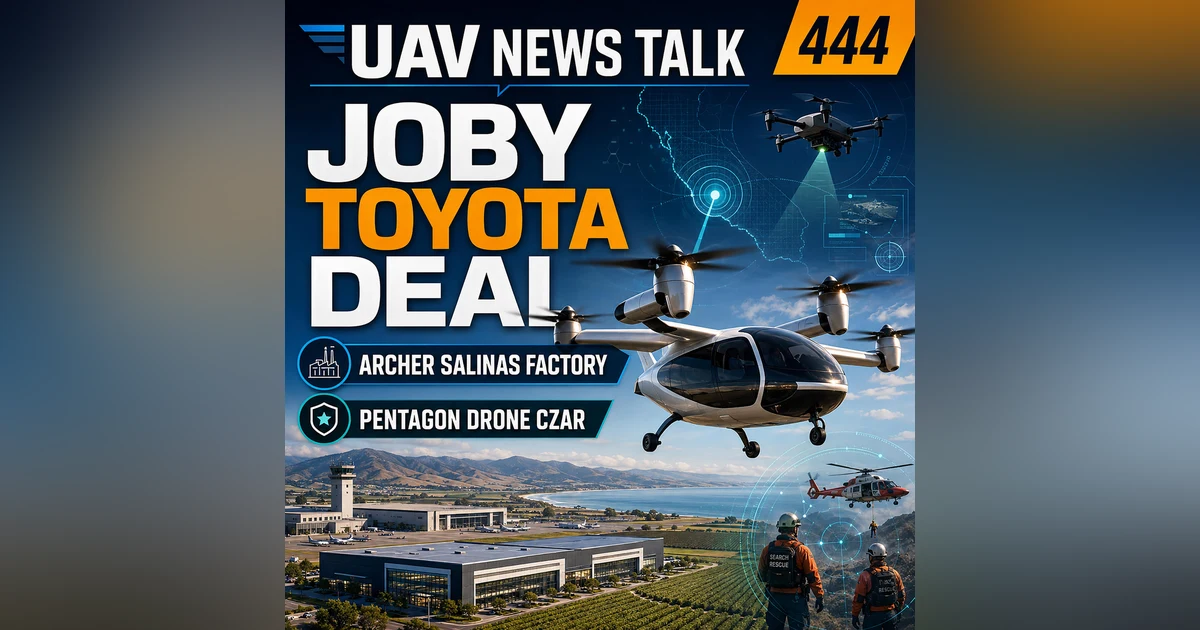
The episode then pivots to eVTOL news in California. Max discusses Archer Aviation’s new agreement with the City of Salinas, including a 10-year through-the-fence agreement for a manufacturing and testing facility near the Salinas airport. Max explains the local context: Salinas has long had a capable airport, including an ILS, and Archer has already been conducting testing there. The new facility involves a large former Coca-Cola building that Archer plans to use as a manufacturing and test hub. Max notes that it is significant to see advanced aircraft manufacturing remain in California, since new technologies are often developed in Silicon Valley but manufactured elsewhere.
That story also includes a new FAA-supported flight-test corridor connecting Salinas, Marina, Hollister, and Watsonville. Max and David discuss why those airports may be useful for testing eVTOL operations, even if they are not obvious commercial markets. Marina is strongly associated with Joby Aviation’s early flight testing, Hollister has also been used for advanced-aircraft activity, and Watsonville is a busy non-towered general aviation airport that could provide useful real-world operating experience. David suggests the airports may serve as practical stand-ins for future vertiport operations.
Next, David covers Beta Technologies’ electric aircraft demonstration work in Hawaii with Surf Air Mobility and Hawaiian Airlines. The program involves Beta’s Alia CTOL aircraft, which uses conventional takeoff and landing rather than vertical takeoff and landing. Max and David discuss why Hawaii is a compelling place for electric aviation: the islands are relatively close together, inter-island travel is common, and shorter routes can help fit within electric aircraft range limitations. They also discuss possible intra-island routes, commuter service, cargo operations, and even sightseeing flights that could eventually replace or supplement some helicopter tour missions.
Another major eVTOL manufacturing story involves Joby Aviation and Toyota. David explains that Joby and Toyota have formed a new manufacturing-focused company, with ownership split between the partners and a path toward exclusive manufacturing support. Max and David discuss Toyota’s manufacturing expertise and how that could help Joby scale production of its four-passenger, one-pilot S4 eVTOL. They also mention Joby’s plan to increase production to four aircraft per month in 2027, while noting that full-scale production depends on FAA certification. Max reiterates his earlier skepticism that both Joby and Archer will achieve certification by the end of 2026, though he hopes both companies succeed.
The final eVTOL story looks at Sora Aviation’s subscale demonstrator for a planned 30-seat S1 eVTOL aircraft. David describes the aircraft as a larger design than most eVTOLs discussed on the show, while Max explains why the 30-seat number matters from a certification and operating-category standpoint. They also discuss the challenge of scaling battery-electric flight to larger aircraft and the likelihood that larger vehicles may require hybrid power solutions.
The episode ends with a fun “you can’t make this up” story: drones dropping one million baby oysters into Galveston Bay. Max and David discuss the use of drones for oyster restoration, comparing it to aircraft dropping trout into remote lakes and drones seeding forests. The result is a lighthearted but meaningful reminder that UAVs continue to find new uses in industries far beyond aviation.


