Can American Drone Technology Compete with DJI? HYFIX H1D, AI Drones, RTK GPS & U.S.-Made Chips


 RSS Feed
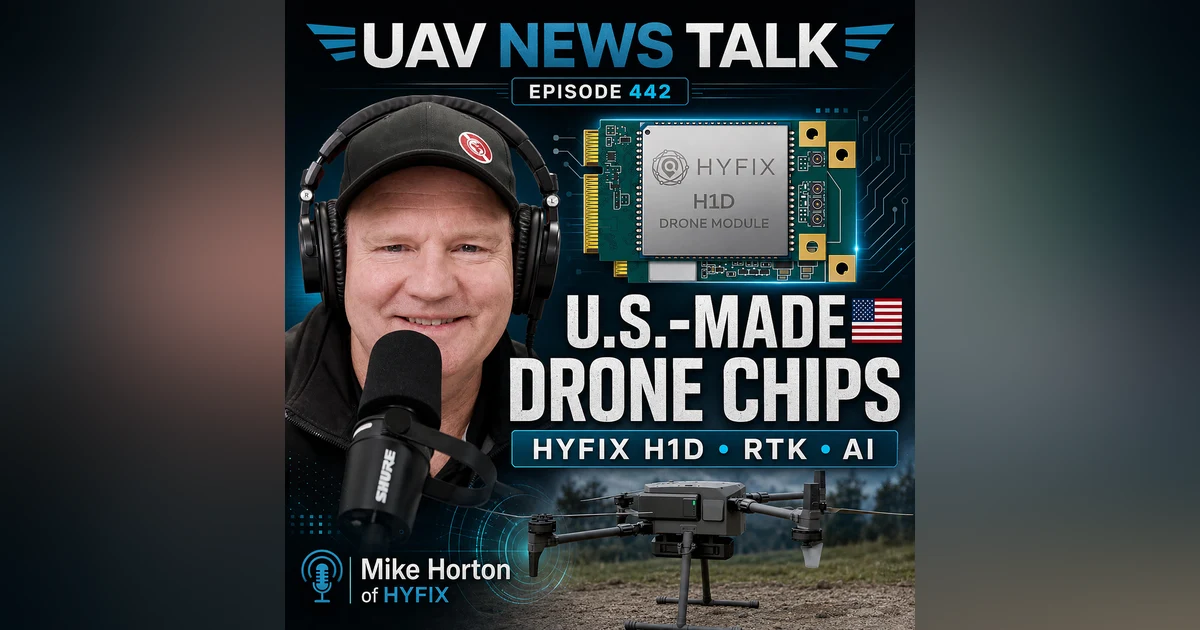
 Can American drone technology compete with DJI? In this episode of UAV News Talk, Max Trescott and David Vanderhoof talk with Mike Horton, CEO and co-founder of HYFIX Spatial Intelligence, about the chips, sensors, software, and positioning technology that may determine the future of the American drone industry.
Mike begins by explaining the basic electronic building blocks inside a modern drone. Even a simple drone needs a flight controller, motors, a battery, and a radio link. Most commercial drones also include a camera, gimbal, and onboard processing so the aircraft can support functions such as object tracking, collision avoidance, and local image processing. The flight controller is especially important because it takes data from the IMU—accelerometers and gyros—and uses algorithms to send commands to the motors so the drone remains stable and responds to pilot or autonomy commands.
A major theme of the interview is the difference between DJI’s highly integrated drone technology and the more component-based approach often used by U.S. drone companies. Mike says DJI has invested deeply in integrating electronics into its own chip architecture. That helps DJI combine video, radio, flight control, processing, and other functions into compact, efficient aircraft. By comparison, many American drone designs use separate components for the flight controller, companion computer, radio link, motor control, IMU, GNSS receiver, and AI processing.
Those separate components may all be excellent individually, but when they are stacked together they add weight, cost, power consumption, support circuitry, memory, and engineering complexity. Mike says that makes it difficult for American drone makers to match DJI-style aircraft in small form factors, especially in the sub-250-gram category. It also affects battery life, cost, and time to market.
Mike then explains HYFIX’s product lineup. The H1 is the company’s core silicon. The H1P is a positioning, navigation, and open-compute module designed around flight control and precision positioning. It includes full-constellation GNSS, RTK support, sensor fusion, PX4 support, and dual-antenna GNSS heading. Mike says dual-antenna heading can reduce dependence on a magnetometer, which may improve reliability in some drone applications. He also discusses LEO satellite tracking, which can provide signals that are harder to jam than traditional GNSS signals.
The H1D is HYFIX’s more complete drone module. Mike describes it as “kind of a complete drone in a module.” It adds RF power amplifiers, long-range video-link capability, additional memory, AI capability, and interfaces for cameras, motors, and gimbals. The goal is to help drone makers integrate more capability into a smaller, lower-power, lower-cost package. HYFIX is also developing a sub-250-gram reference drone to demonstrate what can be built around the H1D module.
The conversation also covers RTK GPS, more precisely RTK GNSS, which can provide centimeter-level positioning. Mike explains that HYFIX’s reference drone includes RTK capability that is typically associated with enterprise-class drones. That precision is important for autonomous operations, drone-in-a-box systems, mapping, inspection, and other applications where reliable positioning matters.
Another key topic is GPS-denied navigation. Mike describes HYFIX’s work on visual inertial odometry, or VIO, which combines camera data with IMU data to estimate the drone’s position and motion when GNSS is unavailable or unreliable. HYFIX is also working on QR-code-based precision landing so a drone can land in or near a drone box even in a GNSS-denied environment. That kind of technology is important for drone-as-first-responder programs, remote security, industrial inspection, and defense applications.
Mike also talks about software integration. HYFIX is building around familiar open-source tools such as PX4 and ROS 2, rather than forcing developers into an entirely new software stack. PX4 supports flight-control functions, while ROS 2 is useful for higher-level autonomy, AI integration, camera processing, data logging, and robotics workflows. That approach may make HYFIX attractive to drone companies that want more integrated hardware but still need flexibility to customize their own aircraft, payloads, and autonomy software.
The episode also touches on the U.S. drone supply chain and semiconductor manufacturing. Mike says drone companies face pressure to reduce cost, improve radio range, shorten development cycles, and build products that can compete with DJI. He argues that U.S.-made drone chips can help by integrating more functions into a smaller and more efficient platform. He also explains that HYFIX has access to U.S. and allied semiconductor manufacturing options, with future plans to push more AI capability into later chip generations.
Near the end of the interview, Max asks how large drone shows control hundreds or thousands of drones at once. Mike explains that drone shows rely heavily on RTK corrections so each drone can maintain precise position. Even if the choreography is preplanned, the aircraft still need connectivity for corrections, telemetry, safety functions, and coordination. RF interference, spectrum management, timing, and reliability all become major engineering challenges as drone shows scale up.
Overall, this episode explains why chips, RTK GPS, AI drones, GPS-denied navigation, and integrated electronics may be central to whether American drone technology can truly compete with DJI.


